Motor oil shortages are emerging amid supply chain disruptions. Plus: freight prices hit an 8-year high, broker bonds and nuclear verdicts under the microscope, a trucking company pays $5.5M for refusing to hire women, and more.
FreightCaviar Weekly Recap.As federal scrutiny deepens over licensing failures tied to the Florida Turnpike crash, the push for road safety gains momentum. Here are this week’s most talked-about freight stories.
Today's Newsletter is Brought to You by HappyRobot.
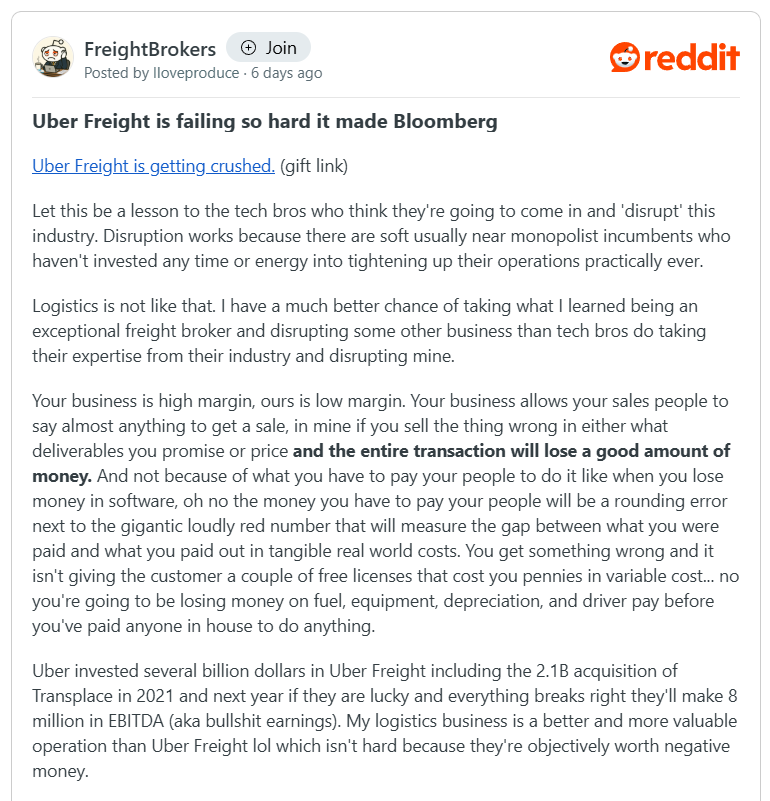
A Redditor on r/FreightBrokers reacted to Bloomberg’s recent report on Uber Freight’s financial performance, offering a pointed reflection on the disconnect between tech-driven disruption and the operational demands of freight. The post sparked renewed discussion around the challenges of scaling in a low-margin, execution-heavy industry.
The Redditor’s core argument: software alone isn’t enough to transform freight. Unlike tech sectors that scale rapidly with minimal cost per user, brokerage missteps carry real, immediate expenses—fuel, equipment, insurance, and driver pay. Freight, the post suggested, is far less forgiving of mistakes than digital-native businesses.
Recent reporting supports the broader point. As Bloomberg noted, Uber Freight has operated at a loss every year since 2017, with a single break-even year in 2022. Its $2.25 billion acquisition of Transplace in 2021 failed to push the business into profitability. Analysts expect only $8 million in EBITDA by 2026, a small return relative to Uber’s other divisions. In contrast, legacy brokers have digitized their operations while maintaining profitability, and many digital-first competitors, like Convoy and NEXT, have exited the space altogether.
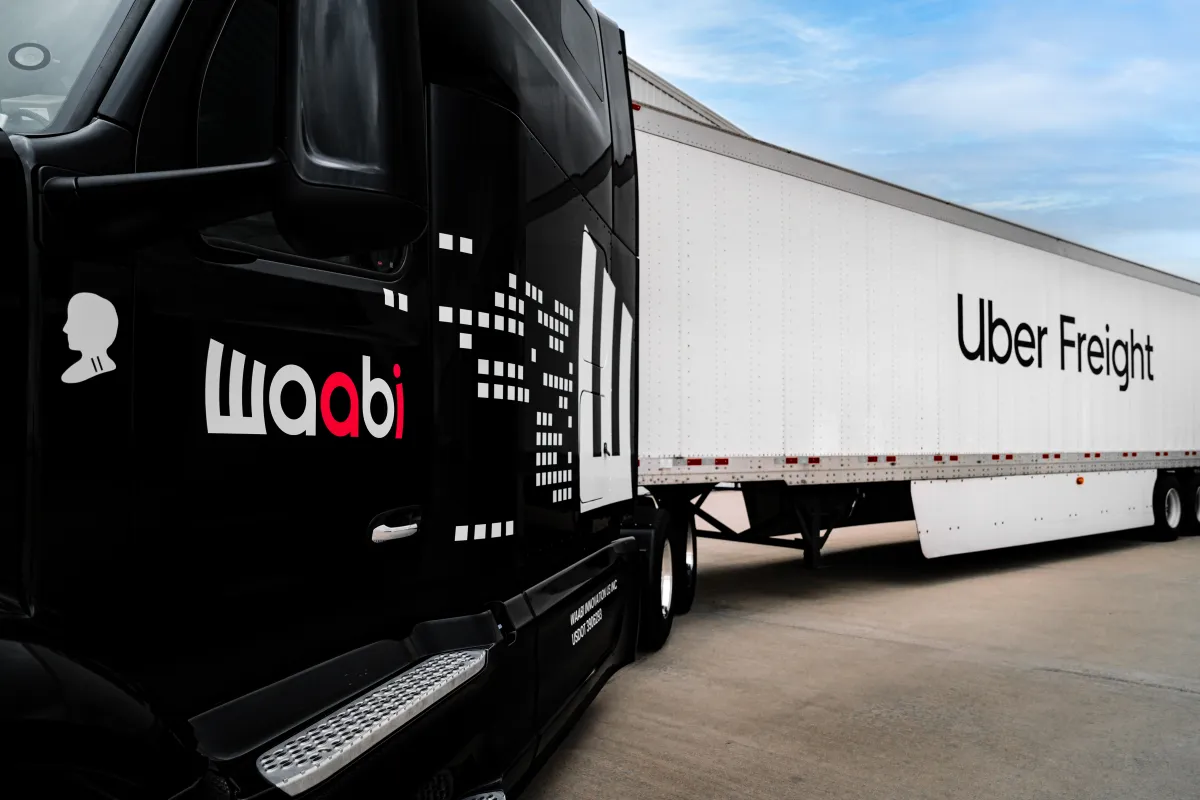
We also reported on Lior Ron’s transition from Uber Freight CEO to COO atWaabi, an autonomous trucking startup. Ron will remain chairman of Uber Freight while helping Waabi scale its driverless freight platform across the U.S. Southwest by year’s end. This move signals Uber’s longer-term interest in autonomy over brokerage.
While Uber Freight is known for its tech, the company had to grind it out the traditional way at the start. In our recent FreightCaviar podcast, Uber Freight Co-Founder Bill Driegert, now helping lead the Convoy tech integration at DAT, reflected on those early days:
“When we started [entering brokerage] we didn’t have the tech. We just had to sling freight. So like we started calling plastics companies in Texas and just scrubbing the DAT to cover freight... we had a TMS built in Google Sheets.”
It’s a reminder that even for tech disruptors, logistics starts with grit, not just code.
What It All Reveals:
Freight remains operationally complex and margin-sensitive, making disruption harder than anticipated.
Uber Freight’s model hasn’t scaled profitably, despite significant investment and strategic acquisitions.
Leadership is now shifting focus toward autonomy, with Waabi seen as a more viable long-term path.
Even Uber Freight started like everyone else—dialing shippers and working the load boards.
As the industry recalibrates post-boom, the convergence of tech and trucking continues, but so does the reality check.
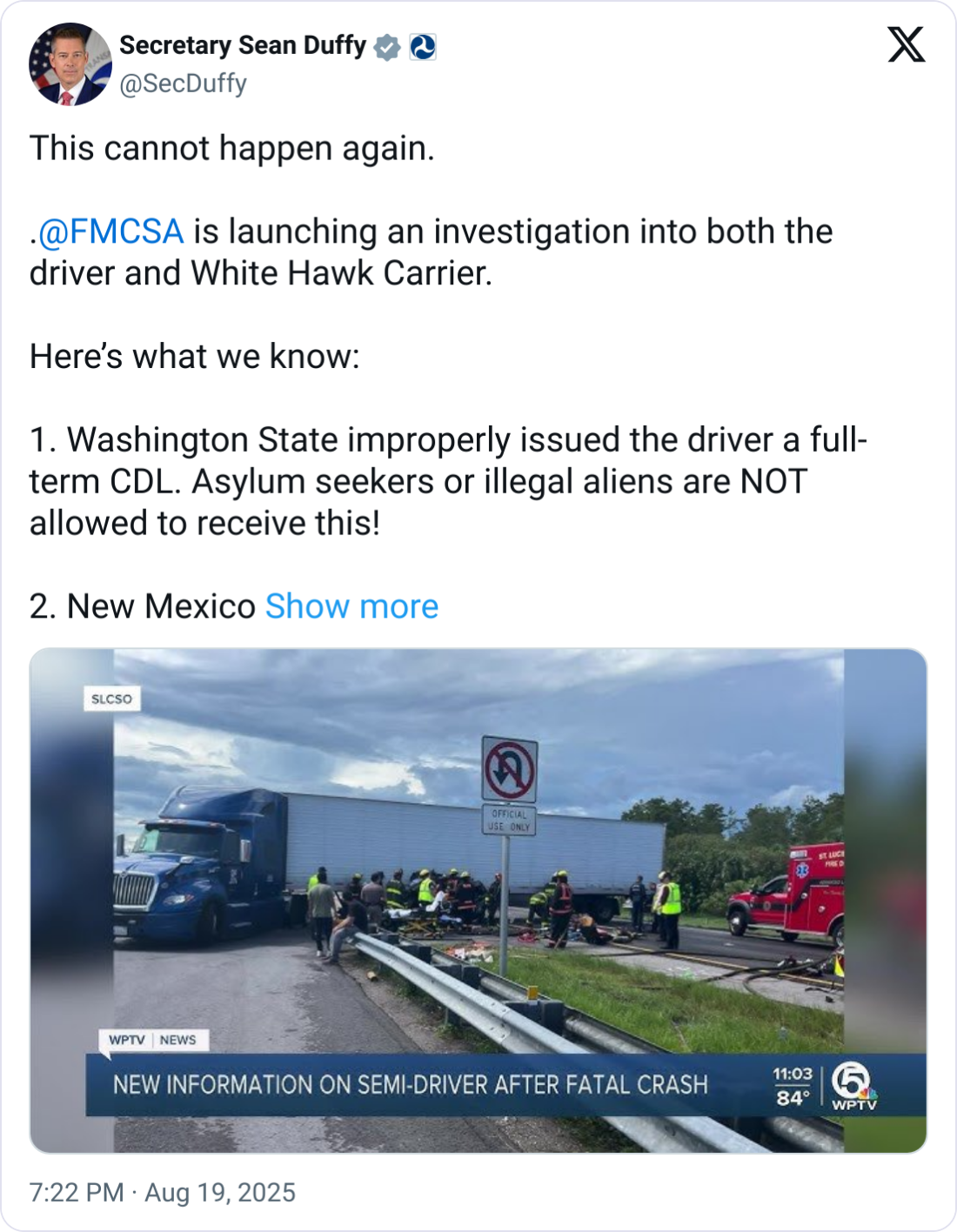
Secretary Sean Duffy is going viral after he confirmed the FMCSA is launching an investigation into White Hawk Carriers and its driver, Harjinder Singh, who is now charged with vehicular homicide after a fatal crash that killed three people on the Florida Turnpike.
The X post cited multiple state-level licensing failures, calling them “despicable” and a direct cause of the tragedy. Duffy stated that if states had followed federal rules, “this driver would NEVER have been behind the wheel and three precious lives would still be with us.”
The Crash
On August 12, Singh attempted an illegal U-turn in St. Lucie County, FL, resulting in a crash that killed three people.
Singh was charged with three counts of vehicular homicide. The FLHSMV said his actions were “reckless” and “without regard for the safety of others.”
An immigration detainer was issued after it was revealed Singh had entered the U.S. illegally in 2018. He now faces deportation following the criminal case.
The federal probe revealed serious gaps in CDL oversight:
Washington state issued Singh a full-term CDL in 2023, despite federal rules prohibiting asylum seekers or undocumented individuals from receiving CDLs.
California issued a limited-term, non-domiciled CDL in 2024. FMCSA is reviewing that issuance for compliance.
New Mexico pulled Singh over for speeding in July 2025 but failed to conduct an English Language Proficiency (ELP) assessment, a federally required step since June 25, 2025.
FMCSA confirmed Singh failed the ELP test, correctly answering only 2 of 12 verbal questions and identifying just 1 of 4 traffic signs.
The Owner-Operator Independent Drivers Association (OOIDA) responded quickly, sending a letter to Secretary Duffy demanding a full nationwide audit of non-domiciled CDL issuance. Among their key recommendations:
A 10-year driving history review for CDL applicants
Stronger carrier compliance enforcement and accident disclosure
Stricter oversight of new carriers to combat chameleon operations
Duffy confirmed a full-scale audit is now underway and emphasized that “this is just the tip of the iceberg.”
We will do a deeper dive on this issue tomorrow, so stay tuned.
FreightCaviar Story of the Week
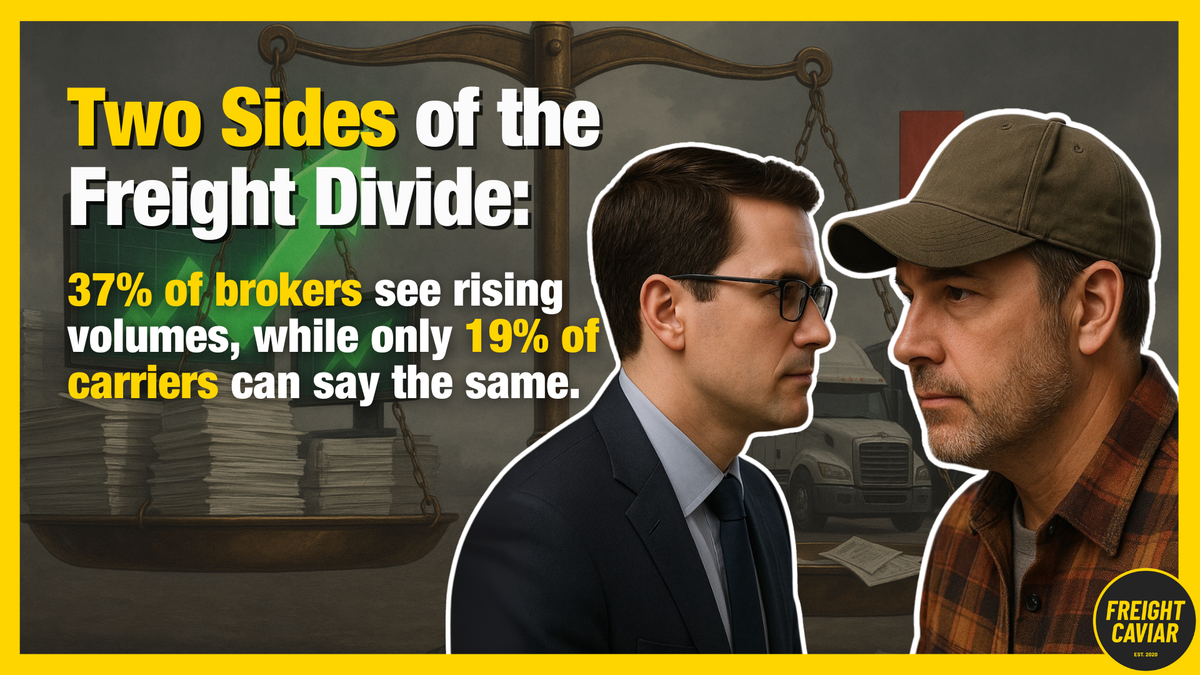
A recent midyear survey from Truckstop.com and Bloomberg Intelligence captured a freight market moving in two directions. Brokers reported stable margins and growing optimism, while carriers showed signs of deepening strain amid weak spot rates and declining load volumes.
The data pointed to a clear split:
37% of brokers reported year-over-year volume growth, compared to just 19% of carriers
78% of brokers saw contract rate gains in the first half of 2025
Nearly 60% of carriers said they hauled fewer loads in Q2 than in Q1
Carrier sentiment also worsened around tariffs, economic policy, and job satisfaction, with fewer planning to invest in equipment or workforce growth this year.
The story painted a picture of a market in two speeds: brokers navigating the downturn with flexibility, and carriers absorbing most of the impact.
Read the full feature to explore what’s driving this split and what it could signal for the rest of the year.
LinkedIn Post of the Week
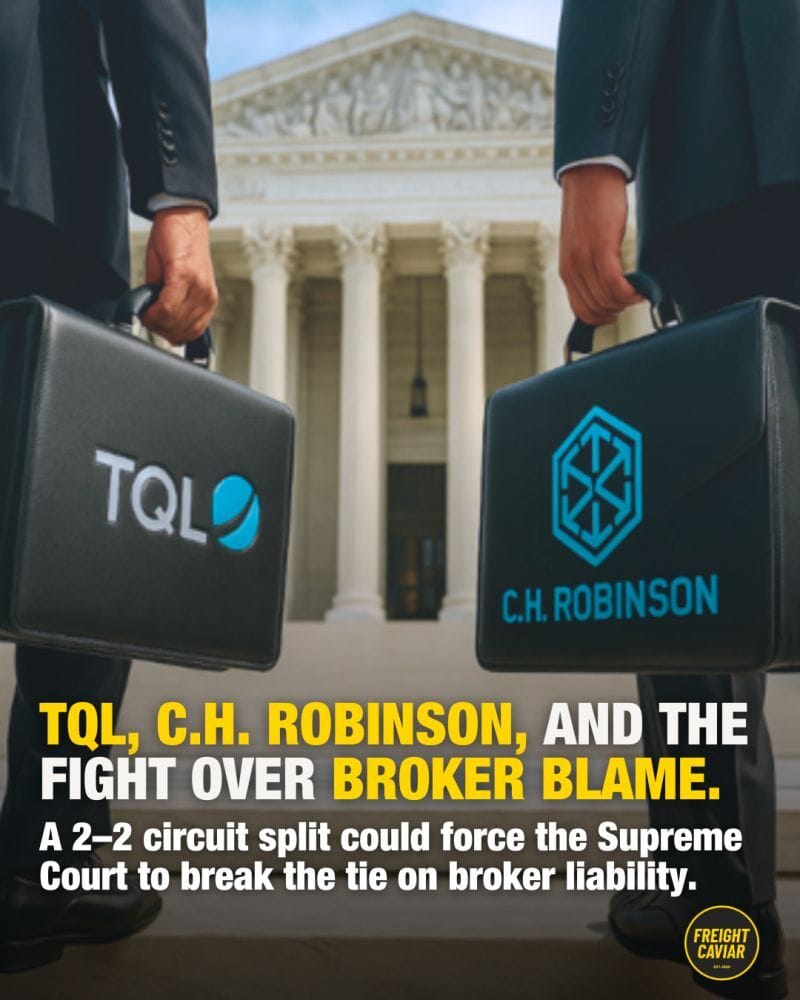
Over on LinkedIn, we highlighted Total Quality Logistics’ move to petition the U.S. Supreme Court following its loss in the Sixth Circuit. The question at the center: Can freight brokers be held liable when a carrier they hire causes a crash?
As we noted in a previous newsletter, this marks the second major case, alongside Montgomery v. Caribe II,asking the Court to resolve the growing split between federal circuit courts. With insurance markets already reacting and liability exposure rising, the pressure for legal clarity is mounting. You can take a look at the newsletter to get a deeper dive on this topic.
Furthermore, read our retrospective to understand what’s at stake and where the legal fight heads next.
FreightCaviar Podcast: We sat down with a true freight tech architect, Bill Driegert, the co-founder of Uber Freight and now Convoy Platform EVP at DAT. He gave his unfiltered take on the Convoy acquisition, the future of AI for brokers, and why relationships still trump algorithms. Catch it on YouTube, Spotify, or Apple Podcasts.
Manifest 2026: FreightCaviar community, tap into massive savings on Manifest 2026. Get registered now and save $1100 on your attendance price. Click here for the deal.
Freight Broker Group Chat: Lost a load to a ghost MC? Just discovered a 15-layer carrier spoof ring? Come swap war stories, drop memes, and ask the stuff no one wants to post on LinkedIn. Join us on forum.freightcaviar.com
FreightJobs.co: Hiring or job hunting in freight? Post or browse roles now at FreightJobs.co.
Hello! I'm Jerome FreightCaviar! I’m into the politics of freight and the impact it will have worldwide. I'm always eager to learn more. Follow me on X @JeromeFreightC
Motor oil shortages are emerging amid supply chain disruptions. Plus: freight prices hit an 8-year high, broker bonds and nuclear verdicts under the microscope, a trucking company pays $5.5M for refusing to hire women, and more.
Four Midwest states set all-time diesel records yesterday. Plus: Texas is going after five CDL mills, a man paid truckers $9,000 a load to haul cocaine, California just opened the door to driverless trucks, and more.
Keep up with the freight broker world in 5 minutes.
Join over 14K+ subscribers to get the latest freight news and entertainment directly in your inbox for free. Subscribe & be sure to check your inbox to confirm (and your spam folder just in case).