“When I say you’re going to require high levels of authenticity and authentication at the point of entry... that is no longer going to be enough to prevent access. You’re going to need multiple points that all need to match in order to unlock access- that’s where we’re going."
FMCSA launched a new carrier registry three weeks ago to stop freight fraud — zero new carriers have been registered since. Plus: PepsiCo is running 41 driverless trucks, peak season and a shrinking driver pool, cameras know where your carriers have been, and more.
Freight AI pilots succeed. Production deployments often don't. Augment CEO Harish Abbott on the change management gap — and what ops leaders need to do before the tech even matters.
The Supreme Court just heard arguments in the broker liability case we’ve been tracking. Plus: oil shipping costs explode, trucking insurance is stuck in 1980, regulators brace for a carrier crackdown, and more.
TGIF. The Supreme Court just heard arguments in the broker liability case we’ve been tracking.We break it down in today's feature.
Plus:
Oil Shipping Costs Just Exploded
Trucking Insurance Is Stuck In 1980
Carrier Crackdown May Overwhelm Regulators
💡
Question of the Day: What percentage of U.S. motor carriers have never been inspected by the FMCSA?
Today's Newsletter is Brought to You by Epay Manager.
🍳 What's Cookin' In Freight
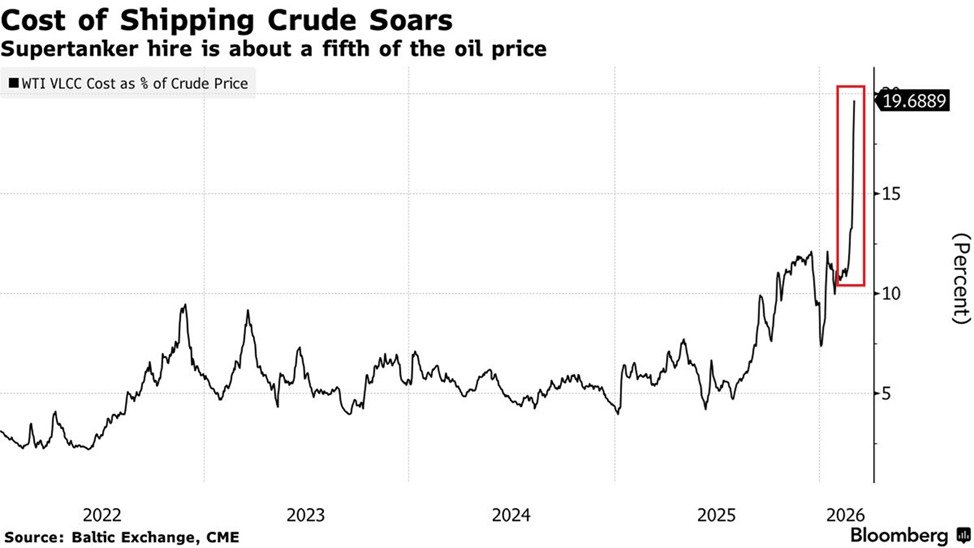
⛽ Oil Shipping Costs Just Exploded. Chartering a supertanker to move 2M barrels of crude from the U.S. Gulf to China now costs over $29M, the highest on record after rates doubled in two weeks. That’s roughly $14.50 per barrel just for shipping, about 20% of the current ~$75 WTI price (WTI = the benchmark price for U.S. crude oil). With traffic through the Strait of Hormuz effectively shut down by the Middle East conflict, Asian buyers are scrambling for U.S. barrels while tanker availability collapses. If this continues, diesel and global fuel supply chains start tightening fast.
🚛 Trucking Insurance Is Stuck In 1980. The FMCSA just told Congress that federal minimum insurance levels haven’t kept up with the real cost of catastrophic crashes. Most interstate carriers are only required to carry $750K, but severe crash costs now regularly exceed $1M, largely due to soaring medical expenses. Adjusted for inflation, that 1980 minimum would equal $2.2M using CPI or roughly $3.7M using medical inflation. Translation: fleets are operating with coverage levels designed for a completely different era of crash costs.
🚨 Chameleon Carrier Crackdown May Overwhelm Regulators. FMCSA Administrator Derek Barrs says the agency will keep pursuing trucking companies that shut down after crashes and reopen under new names, even though the workload may be “more than we can chew.” The agency has about 340 investigators and still relies heavily on self-reported carrier registration data, which makes it easier for bad actors to slip through oversight. With lawmakers now pushing legislation to study the scale of chameleon carriers and develop technology to stop them, federal scrutiny around carrier vetting is likely to intensify.
Your inbox wasn’t built for invoicing. Epay Manager was.
For decades, Epay has deliveredback-office automation for freight brokers that is fundamentally different: it delivers a proactive invoicing workflow by building the carrier invoice from data in your TMS and proactively collecting invoice documents in-platform.
Supreme Court Hears Arguments in Broker Liability Case
The U.S. Supreme Court heard arguments this week in a case that could quietly reshape liability across the freight brokerage industry.
At the center is a 2017 crash in Illinois involving a carrier hired through C.H. Robinson. The injured driver sued both the carrier and the broker, arguing the broker failed to properly vet the trucking company before tendering the load.
Lower courts dismissed the claim under the Federal Aviation Administration Authorization Act of 1994 (F4A), the federal law that largely prevents states from regulating freight brokers' prices, routes, or services.
Now the Supreme Court is deciding whether the law’s “safety exception” allows states to still bring negligence lawsuits against brokers when a crash occurs.
The stakes are significant.
If brokers can be sued for negligent carrier selection, it could force brokerages to investigate carriers more deeply before moving freight, potentially reshaping how loads are tendered across the country.
Supporters of broker liability argue that the current federal oversight system leaves major blind spots.
Logistics attorney Matthew Leffler summarized the problem bluntly during the debate:
💡
“94% of registered motor carriers have no federal inspection data.”
He also noted that regulators themselves are stretched thin, describing the FMCSA as “understaffed and overworked.”
The brokerage industry argues that pushing liability onto brokers would create chaos. Brokers rely on federal licensing and safety ratings to vet carriers, and requiring them to independently audit every carrier could slow freight movement nationwide.
But critics say that’s exactly the point.
If brokers face liability risk, they may simply stop hiring carriers with questionable safety histories, removing unsafe operators from the market faster than regulators can.
That risk is especially acute for smaller brokerages.
As Matthew Leffler told FreightCaviar in January, if brokers are put on the hook for crash liability, “one accident and you’re toast.”
The Supreme Court is expected to rule by July, and the decision could finally settle a split among federal courts over whether these lawsuits are allowed.
For brokers, the question is simple: Are you just the middleman arranging freight, or are you responsible for who’s behind the wheel of the truck?
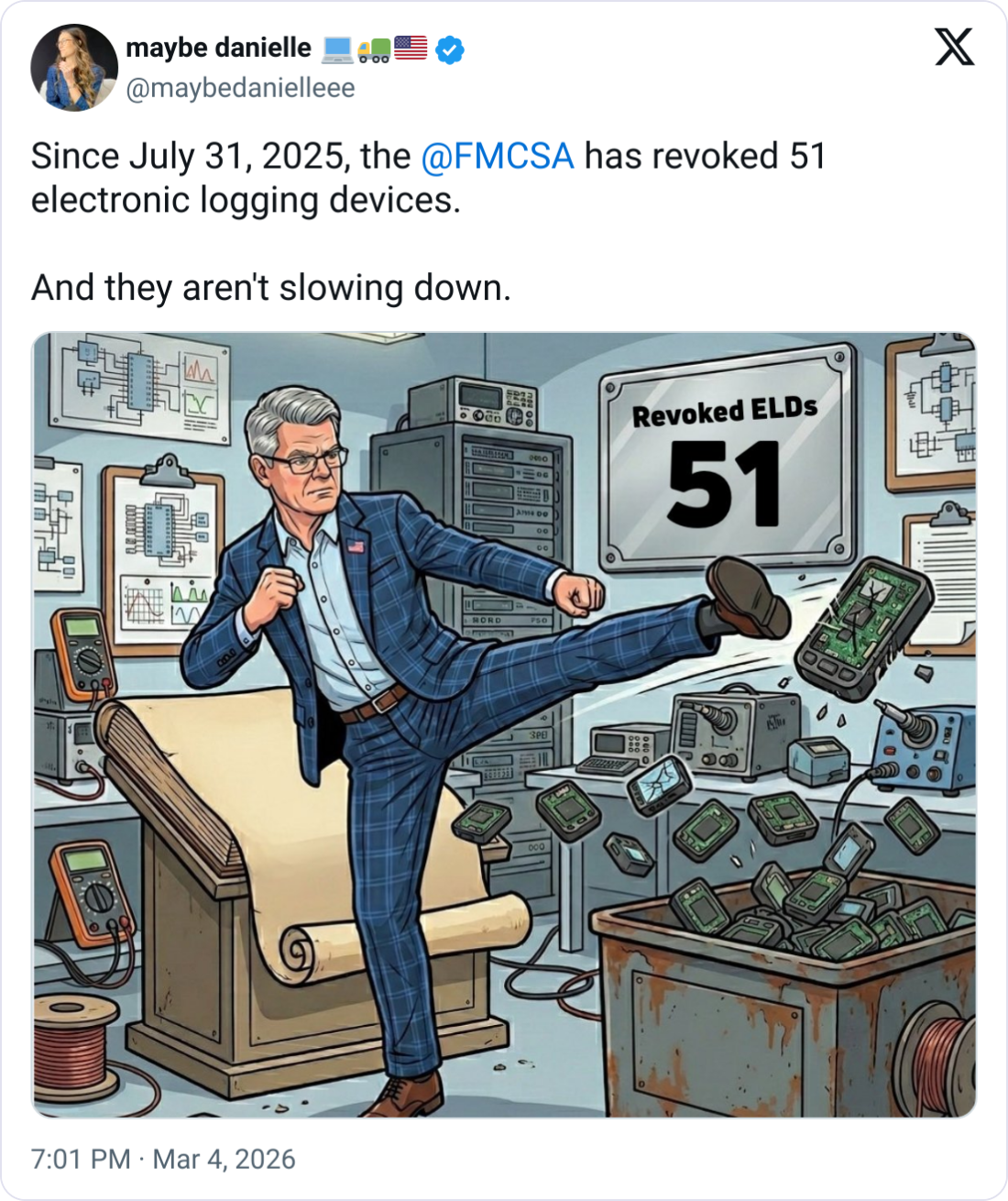
🛡️ ELD Purge Underway. The FMCSA removed dozens of electronic logging devices from its approved list after finding compliance issues, forcing fleets using those systems to switch vendors.
⚖️ Tariff Refund Fight Begins. A federal court ordered the first step toward returning tariff payments after ruling the Trump administration’s calculation method was illegal, potentially opening the door to billions in refunds for importers.
🚢 Hormuz Shipping Disruption Spreads. Container bookingsto the Arabian Gulf have reportedly dropped by more than 80% as attacks and insurance risk reshape global shipping lanes.
🦾 Driverless Truck Debate Returns. Lawmakers are again sparring over autonomous trucking rules as companies push for wider deployment on U.S. highways.
🚨 Massive Meth Bust in Semi. Federal agents seized over 900 pounds of liquid meth hidden inside a truck’s fuel tank, one of the largest trucking-related drug busts this year.
“When I say you’re going to require high levels of authenticity and authentication at the point of entry... that is no longer going to be enough to prevent access. You’re going to need multiple points that all need to match in order to unlock access- that’s where we’re going."
FMCSA launched a new carrier registry three weeks ago to stop freight fraud — zero new carriers have been registered since. Plus: PepsiCo is running 41 driverless trucks, peak season and a shrinking driver pool, cameras know where your carriers have been, and more.
The freight boom arrived. For some carriers, it arrived too late. We explain why in today's feature. Plus: real gouda fellas, satisfactory doesn't mean safe, LTL is waking up, and more.
Keep up with the freight broker world in 5 minutes.
Join over 14K+ subscribers to get the latest freight news and entertainment directly in your inbox for free. Subscribe & be sure to check your inbox to confirm (and your spam folder just in case).