Freight AI pilots succeed. Production deployments often don't. Augment CEO Harish Abbott on the change management gap — and what ops leaders need to do before the tech even matters.
The freight boom arrived. For some carriers, it arrived too late. We explain why in today's feature. Plus: real gouda fellas, satisfactory doesn't mean safe, LTL is waking up, and more.
Plus, USPS gives non-domiciled CDL carriers an 11-day deadline, the spot-to-contract spread starts squeezing 3PLs, Knight-Swift trims its Q1 guide but stays bullish, and more.
Good Monday morning. CBS turned the camera on brokers and called out C.H. Robinson by name. The chameleon carrier story just got a lot closer to home.
Plus:
USPS Drops a May 1 Hammer
The Spot-Contract Spread Is Closing
Knight-Swift Cuts Its Guide
and more.
💡
Question of the Day: Chameleon carriers are ___ times more likely to be involved in crashes, according to risk firm Fusable. (Answer in feature story).
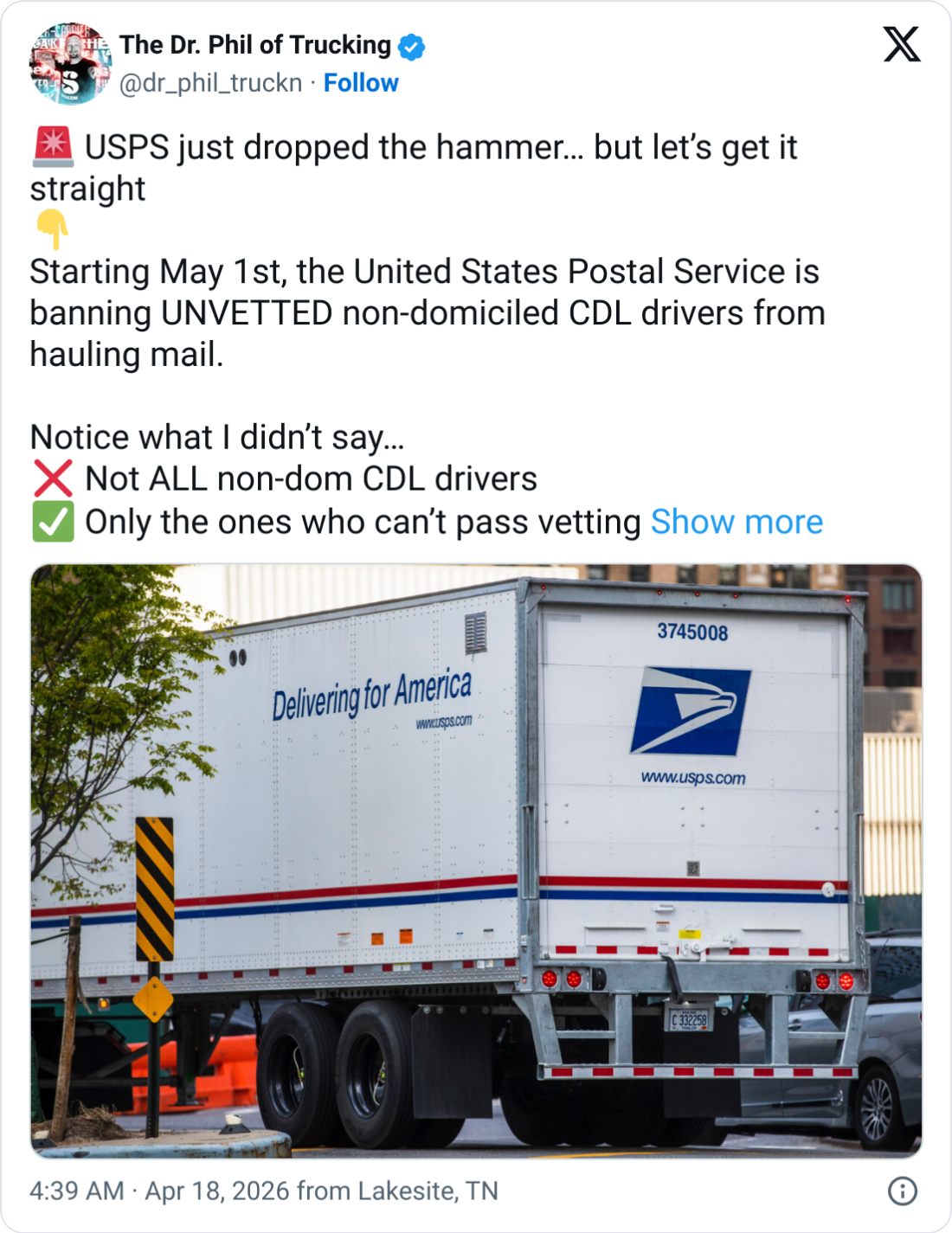
🚨 USPS Sets May 1 Deadline. Starting May 1, the Postal Service will ban unvetted non-domiciled CDL drivers from transporting mail, one of the largest single-employer enforcement actions to follow the FMCSA's final rule. USPS moves roughly 40% of U.S. mail volume via contract carriers. Carriers with non-domiciled drivers on USPS lanes have 11 days to get compliant or lose the work. The crackdown that started with states is now hitting contracts.
📉 The Spread Is Closing, and 3PLs Are Feeling It. Spot rates have climbed fast enough that the gap between spot and contract is shrinking, and that's squeezing 3PLs who built their margin model around a wide spread. When spot runs above contract, asset-light brokers lose their arbitrage edge, and shippers start questioning the value of the middleman.
⚖️ Knight-Swift Cuts Q1 Guidance. KNX trimmed its Q1 earnings guidance but held its bullish outlook on TL fundamentals, citing capacity discipline and rate momentum heading into Q2. The guide cut matters less than what management said alongside it: pricing is moving, capacity is still exiting, and the structural setup hasn't changed. One quarter of softness doesn't undo three years of tightening supply.
A unified platform for RFP pricing and freight orchestration
GoodShip brings together pricing, bid history, contract management, and analytics into a single system, giving teams the ability to evaluate opportunities, align around the right lanes, and orchestrate pricing decisions across their network with confidence.
With Laney, GoodShip’s AI Transportation Analyst, teams can ask questions about their operations and get clear, actionable answers in seconds through a conversational interface, making it easier than ever to understand what’s happening across the network and where to improve. The result: faster RFP responses, smarter decisions, stronger margins, and a more scalable brokerage.
The CBS Sunday Morning segment that aired yesterday didn't just revisit Super Ego, the Serbian-based carrier network FC covered last Monday. It went one layer deeper and named the brokers on the other side of the load confirmation.
C.H. Robinson, the largest freight broker in the country, was specifically identified for awarding Super Ego its "Carrier of the Year" honor in the 1,000+ truck category for 2025, a carrier that had racked up nearly 15,000 safety violations and 500 accidents over the prior two years.
The segment's core argument: chameleon carriers don't survive without someone booking their freight. And brokers, not just regulators, are making that possible.
As the largest broker in the country, trusted by 450,000 contract carriers, C.H. Robinson has outsized influence over which carriers stay on the road and which don't
The segment argued brokers like C.H. Robinson profit from cheap capacity provided by chameleon networks while bearing none of the safety accountability
In an undercover portion of the report, Rob Carpenter with CBS approached C.H. Robinson's booth at an industry conference with a camera hidden, testing how the nation's largest freight broker handles carrier vetting in practice.
The numbers CBS put on screen:
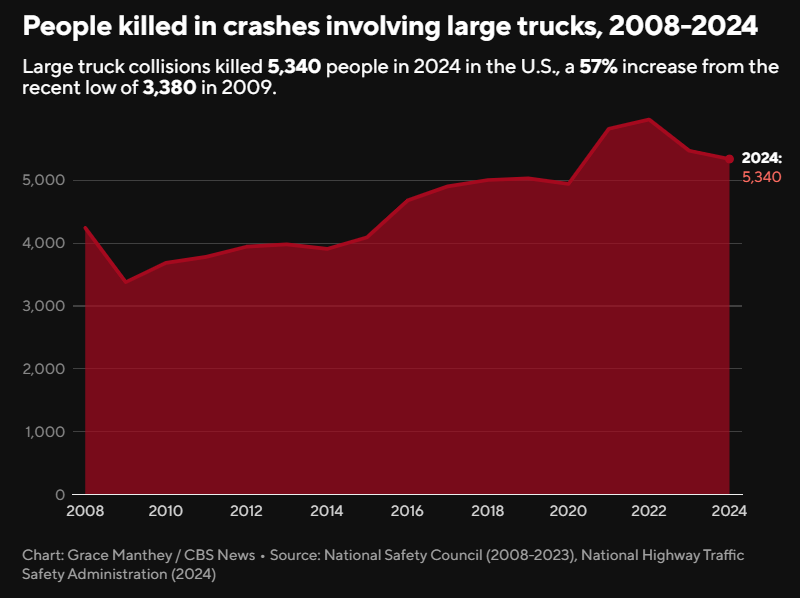
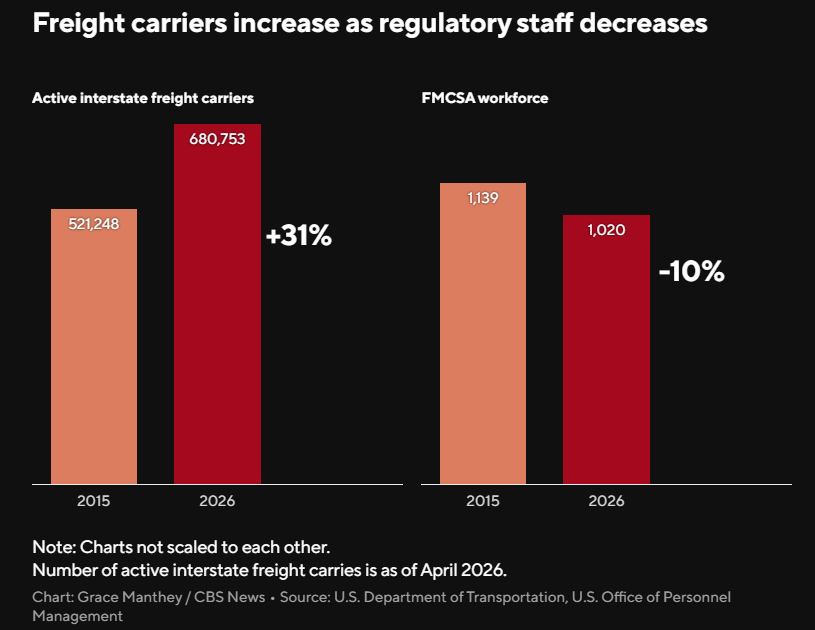
CBS put this chart on national television Sunday morning, right before naming C.H. Robinson. Image Source: CBS News
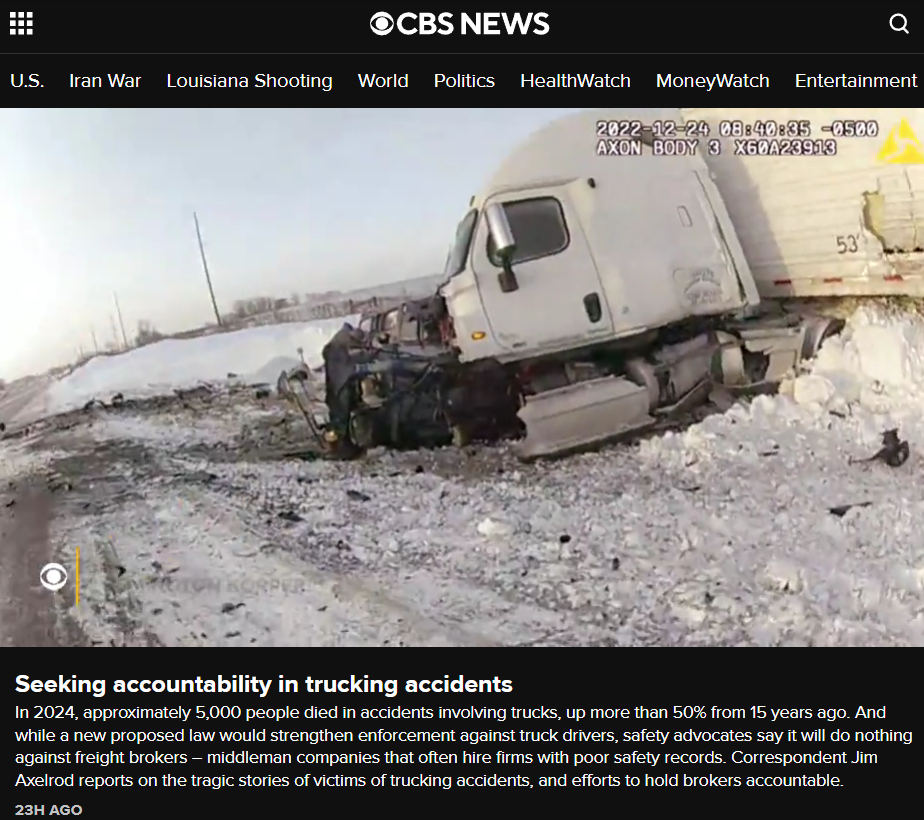
Approximately 5,000 people died in truck accidents in 2024, up more than 50% from 15 years ago
Chameleon carriers are four times more likely to be involved in crashes, per risk firm Fusable
An estimated 10–20% of the 700,000 trucking companies in the U.S. operate somewhere on the chameleon spectrum
It costs $1,000 and 21 days to legally start a trucking company in the U.S., no citizenship required
More trucks on the road, fewer people watching them. Image Source: CBS News
The Industry Pushes Back
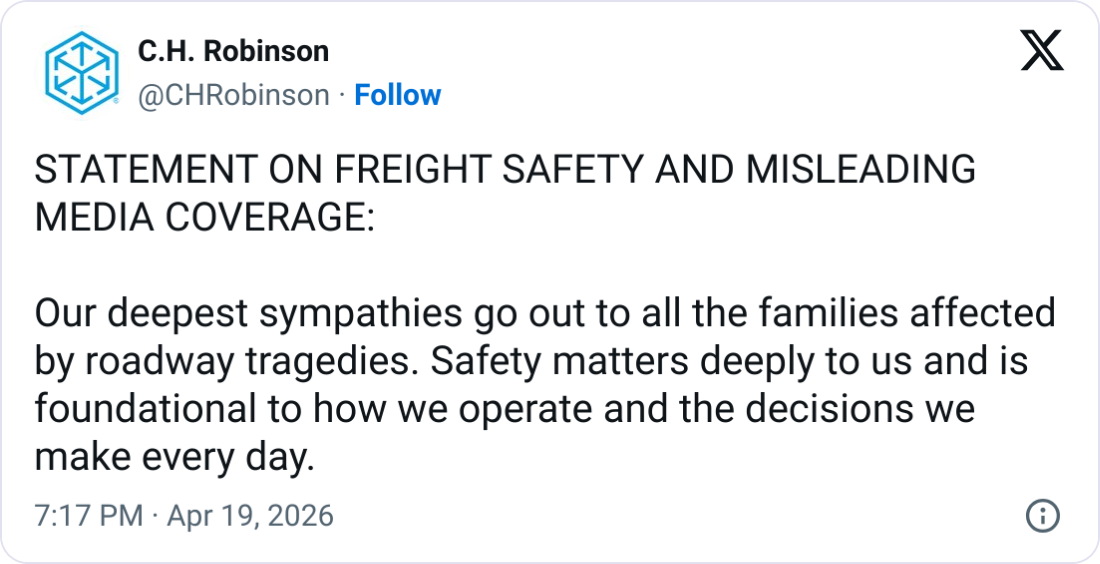
C.H. Robinson issued a statement calling the CBS coverage "misleading," disputing the framing that brokers bear safety responsibility for carriers they don't own, employ, or directly supervise.
TIA President Chris Burroughs backed that position: "Freight brokers do not own trucks, employ drivers, or control carrier operations. Those responsibilities rest with federally regulated motor carriers and the FMCSA."
He pointed to the real gap — 94% of federally authorized trucking companies have never undergone a federal safety audit — and argued that shifting liability to brokers without operational control distracts from that systemic failure.
But TIA also acknowledged something important: it has lobbied for years for a high-risk carrier list and a modernized FMCSA safety rating system, and has faced sustained opposition from trucking organizations in doing so.
The Legal Stakes
The legal stakes here go beyond optics.
The Supreme Court is currently weighing Montgomery v. Caribe Transport II, a case that directly tests whether freight brokers can be held liable under state tort law for negligent carrier selection.
A ruling is expected this term. If the Court finds against preemption, the entire broker liability landscape changes overnight.
CBS aired this segment the weekend before that ruling could drop.
So what?
The carrier vetting question is no longer theoretical. Shippers are watching this coverage. Plaintiff attorneys are watching it. And if SCOTUS rules against brokers on preemption, every load confirmation becomes a potential exhibit.
Time to document your carrier selection process, and cut carriers you've been meaning to cut, before the ruling, not after.
"While I consulted on and did the undercover interview a lot goes into these and Michael Kaplan did an awesome job, @GenLogs again played a huge role." - Rob Carpenter, Compliance & Safety expert. Watch the full CBS News segment here.
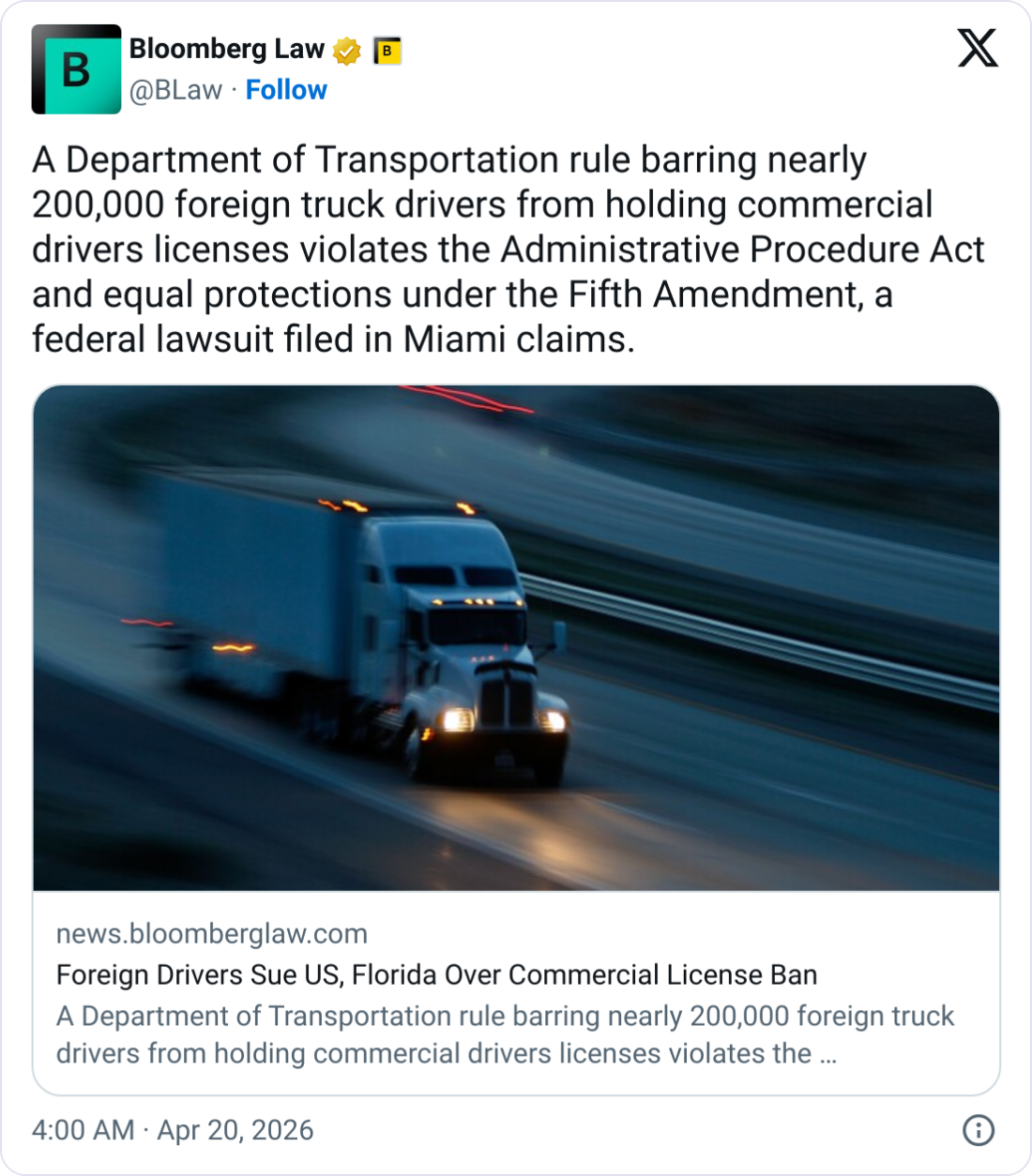
⚖️ Drivers Sue Over CDL Rules. Nineteen non-domiciled CDL drivers filed a lawsuit against FMCSA and Florida, alleging the crackdown on non-domiciled licensing is causing "ongoing and irreparable harm."
💰 Tariff Refund Portal Launches. CBP's tariff refund portal goes live today. Shippers who overpaid on Trump-era tariffs can now begin filing, though roughly one-third of imports are excluded from the process.
🌎 Mexico Truck Exports Slip. Truck exports from Mexico to the U.S. fell in March, adding to signs that tariff uncertainty is cooling cross-border freight flows even as domestic capacity tightens.
📬 Missouri ELP Bill Advances. Missouri's English language proficiency bill is heading to the Senate; it would impose fines on both drivers and carriers for non-compliance, making Missouri one of the toughest states on ELP enforcement.
📚 A Trucker Wrote the Book. Third-generation trucker Gord Magill's End of the Road: Inside the War on Truckers tells the story of what happened to the profession from someone who lived it.
I’m Adriana, a writer and editor at FreightCaviar. I’ve covered everything from freight tech to industry lawsuits and market shifts, helping scale us to almost 14K subscribers. My goal: to make logistics stories digestible, clear, and fun to read.
Freight AI pilots succeed. Production deployments often don't. Augment CEO Harish Abbott on the change management gap — and what ops leaders need to do before the tech even matters.
The freight boom arrived. For some carriers, it arrived too late. We explain why in today's feature. Plus: real gouda fellas, satisfactory doesn't mean safe, LTL is waking up, and more.
Spot rates just hit record highs, while the carrier pool is shrinking. Plus: shippers get a win on trucking liability, the oldest tax in trucking is on the chopping block, Ohio puts 5,000 CDL holders on notice, and more.
Keep up with the freight broker world in 5 minutes.
Join over 14K+ subscribers to get the latest freight news and entertainment directly in your inbox for free. Subscribe & be sure to check your inbox to confirm (and your spam folder just in case).