
Newsletters
🎣 Stop Being a Basic Brokerage
Technology is how you survive. Expanding into niches is how you become impossible to replace.
Technology is how you survive. Expanding into niches is how you become impossible to replace.
The March LMI reads like 2022 with prices at a 4-year high. Plus: warehouse arson in California, Mexico's trucker strike enters day three, and broker margins are still underwater.

Deployment expands the GoodShip platform beyond shippers to support carriers, brokers, and other logistics service providers
Technology is how you survive. Expanding into niches is how you become impossible to replace.

Contributor Post by Matt Silver, CEO & Co-Founder of Cargado
Matt Silver is the CEO & Co-Founder of Cargado, a platform focused on simplifying and scaling cross-border freight across the U.S., Mexico, and Canada. Cargado helps brokerages and logistics teams navigate the complexity of cross-border operations with better infrastructure, visibility, and access to capacity.
This piece originally appeared in our 2nd edition of the FreightCaviar Print Magazine. Click here to learn more and to subscribe.

I have the honor of working with well over 200 logistics companies across North America. I spend my days talking with leaders across the spectrum: Mexican leaders at the largest brokerages, owners of some of the top Canadian logistics companies, and founders of startup brokerages who share my obsession with cross-border freight.
Everyone has a different perspective on how to move their company forward in 2026.
But after hundreds of these conversations, I keep coming back to the same two truths:
This post is both a wake-up call and a playbook.
The wake-up call: the window to modernize is closing. The playbook: here's how to use that foundation to become a more dynamic, multi-dimensional brokerage.
The phrase "digital freight brokerage" is dead. I'm calling time of death.
Everyone is digital now. That's not a differentiator — it's table stakes.
But here's what I'm still seeing: teams who are "digital" on paper but still drowning in manual work. They have a modern TMS. They're on the load boards. But their people are still:
That's not modern. That's just digital window dressing on the same old grind.
Meanwhile, the brokerages that are actually investing in technology as a scaling engine look completely different:
This is how you scale. Not by hiring more people to do manual work. By removing the manual work and repositioning your people to have a much larger impact.
I still know teams who just moved off AS400. Black screens with green text. If that's you, the gap between where you are and where the market is heading is getting wider every quarter.
The wake-up call is simple: if you're not actively investing in technology that frees your team from commodity work, you're going to struggle to keep up.
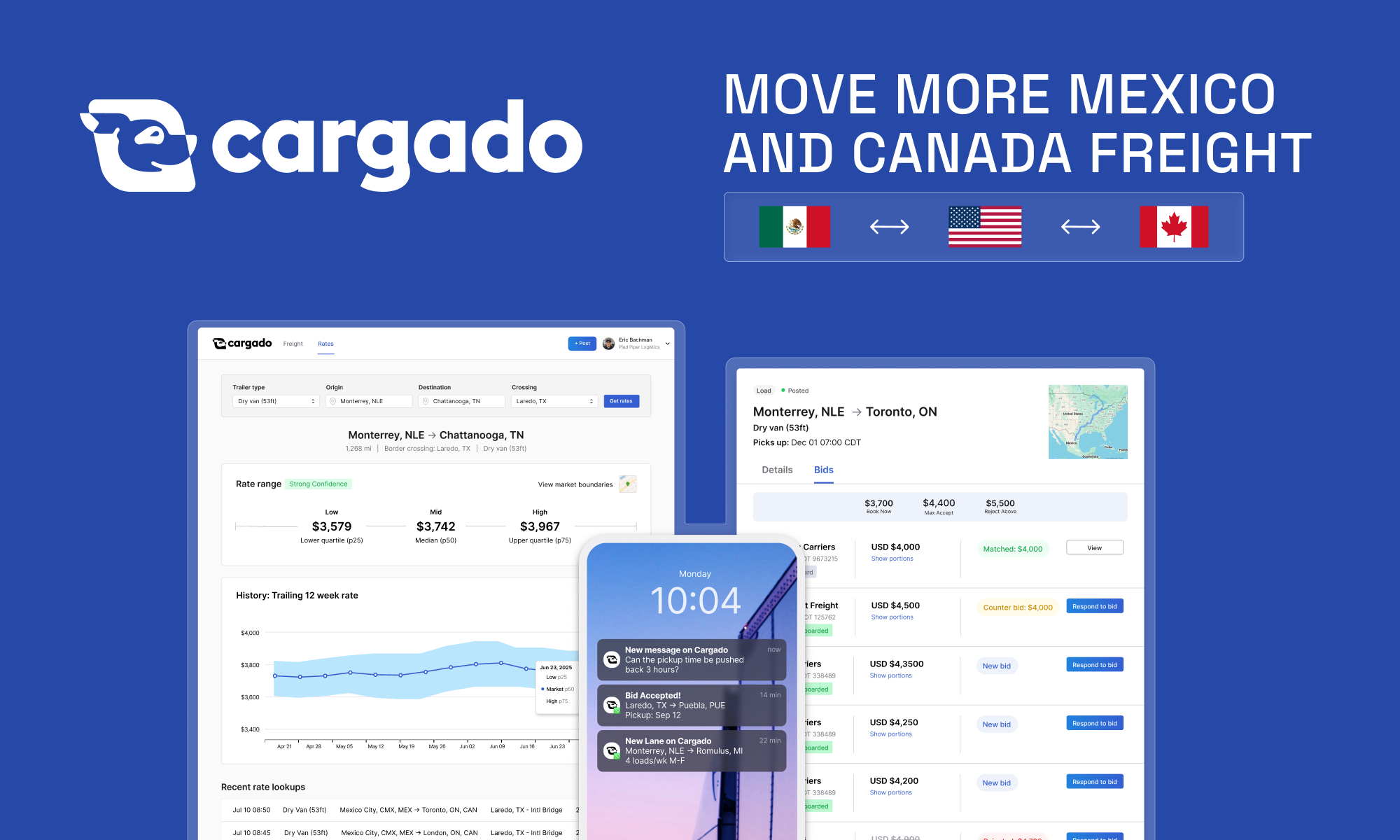
Cargado gives you everything you need to grow your Mexico and Canada business easily. Look up market rates instantly with Cargado Market Rates, finish RFPs in minutes using the Cargado Add-In for Excel, and book trusted Mexico and Canada carriers fast all in one marketplace app.
Here's the thing about technology: it's necessary but not sufficient.
If you automate everything and then keep doing the same generic dry van work on the same generic lanes, you're still a one-dimensional brokerage. You've just become a more efficient one-dimensional brokerage.
The real opportunity comes when you use that foundation to expand into the freight that most brokers avoid.
Mexico. Canada. Open deck. The niches that get written off as "too complex" or "too risky."
That complexity is exactly why there's margin in it. And more importantly — every niche you add makes you more valuable to your customers and harder to replace.
A one-dimensional brokerage is easy to commoditize. You do dry van. So does everyone else. Price becomes the only differentiator.
A dynamic brokerage is different. When you can handle a customer's domestic freight and their Mexico moves and their open deck projects, you're not a vendor anymore. You're embedded in their operation.
Here's what happens when you start adding capabilities:
Every niche you expand into gives your existing customers more reasons to consolidate with you. And when you talk to new prospects, it gives them more reasons to say yes — because you're not just another broker asking for "a shot."
Mexico and Canada. Nearshoring is not a headline — it's a structural change. Manufacturers are moving production into Mexico, adding plants across Canada, building DCs around Laredo. Every one of those moves creates cross-border friction. If you're the broker who actually understands how freight flows through the gateways, where capacity wants to be, and what Carta Porte means for day-to-day operations — you become essential, not optional.
Open deck. More complex. More operationally demanding. Permits, escorts, route planning, site constraints. Which is exactly why most one-dimensional brokers avoid it. If your team leans in and builds real capability here, you unlock project freight, capex moves, and a whole category of business that your competitors won't touch.
Most brokerages think of this freight as "too hard." That's exactly why there's opportunity for the ones willing to expand.
Let's get the snark out of the way:
No one likes a basic broker.
A basic broker in 2026:
If your entire positioning is, "We're a relationship-driven brokerage that communicates well and really cares about our customers" — cool.
You've just described 90% of the industry.
Basic is a mindset:
The dynamic brokerage says:
"Give us the hard stuff — Mexico, Canada, open deck. We're building capabilities there because that's where we can actually make a difference."
That mindset shift completely changes how your customers see you and why new prospects say yes.
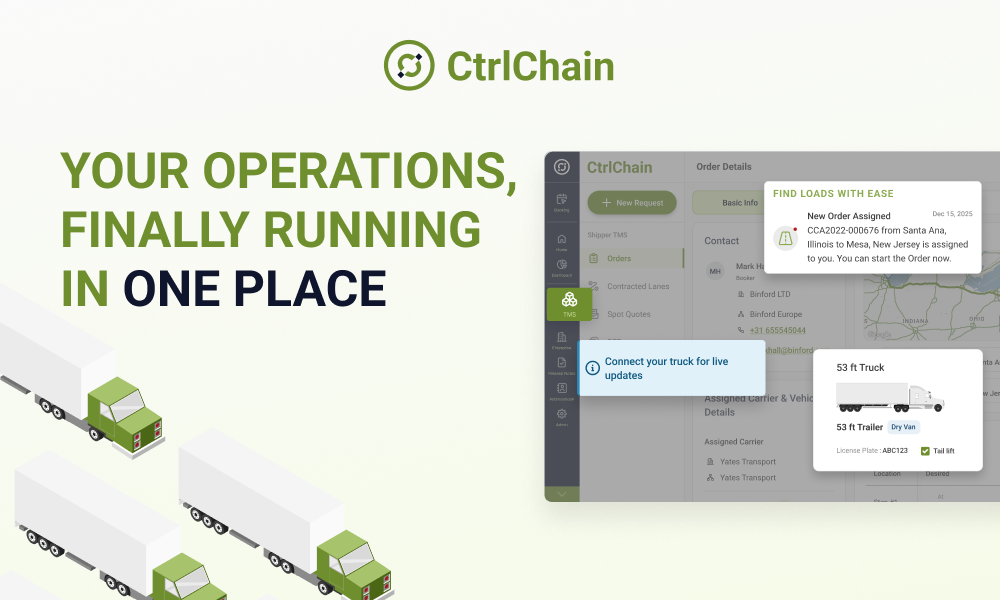
Your Road Operations, Finally Running in One Place
Most logistics teams juggle planning, carrier emails, spreadsheets, and status calls. A unified TMS solves most of these issues by pulling everything into one clean workflow.
Orders flow in automatically. Contracted lanes assign the right carrier without human input. Spot quotes run through a quick, structured quote flow. Every milestone updates in real time, every document lands in the right place, and every stakeholder sees the same truth.
It is the control layer that road logistics has always needed: less noise, fewer steps, and full transparency from booking to delivery.
Knowing that technology is required and niches are the opportunity is one thing. Actually building a more dynamic brokerage is another.
Here's how I'd approach it.
Before you can expand into new areas, you need capacity. Not truck capacity — people capacity.
Look at where your team spends time today. Every hour spent manually pricing, rekeying, posting, and chasing is an hour not spent on building new capabilities or deepening customer relationships.
The goal is to automate the commodity work:
You don't need to solve everything at once. Pick the biggest time sink and fix it first. Then move to the next one.
This isn't about buying shiny tools. It's about buying back your team's time so you can redeploy it toward growth.
Look at your current customer base. Where are they already asking for help that you're saying no to?
Those are your expansion opportunities. You don't need to go find new customers — you need to become more valuable to the ones you already have.
You don't need to become a full-service cross-border and open deck shop overnight.
Pick one area to expand into first:
Assign an internal owner. Find the right partners and platforms to accelerate your learning. Start with one lane, one customer, one use case.
The big mistake is waiting until you feel "ready." You will never feel ready. You need a customer willing to work with you, and partners who can fill the gaps while you learn. The rest you figure out in motion.
Once you've built real capability in a new area, your prospecting changes.
Instead of:
"We're a relationship-driven brokerage that provides excellent service. Can we get 15 minutes?"
It becomes:
"I saw you're ramping production out of Monterrey and pushing freight into the Midwest. Most teams underestimate how messy cross-border gets at that volume. We've built real capability there — want to see what we're seeing on capacity and risk right now?"
One sounds like every other broker. The other sounds like someone who's built something specific and valuable.
The goal isn't to add one capability and stop. It's to keep becoming more dynamic.
Every new area you expand into makes you harder to replace and more valuable to your customers. Mexico today. Canada next quarter. Open deck after that.
The most valuable brokerages in 2026 won't be the ones who picked one niche and went deep. They'll be the ones who kept expanding their capabilities until they became indispensable.
After everything I just said, you might think I'm bearish on brokerages.
It's actually the opposite.
There's a wave of modern technology pouring into freight: AI-driven pricing, better visibility, smarter TMS platforms, marketplaces that actually understand cross-border nuance.
The brokerages that lean into those tools — not as shiny toys, but as infrastructure that frees them to expand — are going to separate themselves quickly.
We're going to see M&A pick up as legacy brokerages decide they're done. And we're going to see a group of operators use this moment to build extremely dynamic, multi-dimensional businesses.
Not because they yelled the loudest about being "digital." Because they built the foundation to scale — and then kept expanding into areas where others stayed one-dimensional.
If there's a theme for 2026, it's this:
Technology is how you survive. Expanding into niches is how you become impossible to replace.
The one-dimensional broker will keep refreshing load boards, complaining about rates, and blaming the market.
The dynamic brokerage will keep expanding — picking up new capabilities, new freight types, new geographies — until their customers can't imagine working with anyone else.
It's 2026.
Time to stop being basic.
It's time to get Cargado if you aren't using it today. Your competition sure is.
Stay updated on the latest in cross-border logistics and freight tech by subscribing at CongratsOnAllTheProgress.com.

The March LMI reads like 2022 with prices at a 4-year high. Plus: warehouse arson in California, Mexico's trucker strike enters day three, and broker margins are still underwater.

“I used to hate a freight broker. All they're trying to do is take my money. That was the attitude… until you realize that if there's a load of freight, whether it’s intermodal, brokerage, or assets, the load is going to go the way it’s supposed to go. You can fight it, but you’ll go broke.”

The contract cushion brokers relied on is nearly gone. Here's what that means for your margins. Plus: FMCSA is pulling ELDs fast, Hormuz cracks open - barely, $821k ghost load scheme, and more.


Plus: Brokers return, Hormuz spikes rates, LTL stays stuck in a tough year, and more.
Join over 14K+ subscribers to get the latest freight news and entertainment directly in your inbox for free. Subscribe & be sure to check your inbox to confirm (and your spam folder just in case).