Two bills just dropped in the Senate that could reshape trucking faster than anything since deregulation. Plus: Russian hackers targeted your load board, flatbed rejection rates just hit 40%, and a robot is taking the Houston-Dallas overnight run.
This week: The Dalilah Law, a trucking bankruptcy that wiped out thousands overnight, a FreightGuard civil war on Reddit, and the payroll data that's predicting Q4 capacity.
Indiana pulled the trigger on carriers employing illegal CDL holders. Plus: tariff ruling could flood LA with imports, DC finally moves on double brokers, spot rates are outrunning contract, and more.
Plus: LAPD busts a $3.9M cargo theft ring, Nuvocargo and UPS expand in North America, U.S. moves to ease rules for self-driving trucks, Funny Freight Friday, and more.
Happy Friday. Ports are stalling. Small businesses are hurting. But signs of tariff de-escalation are starting to show. Is it too late to reverse the damage?We're breaking down the key tariff news from this week in today's feature
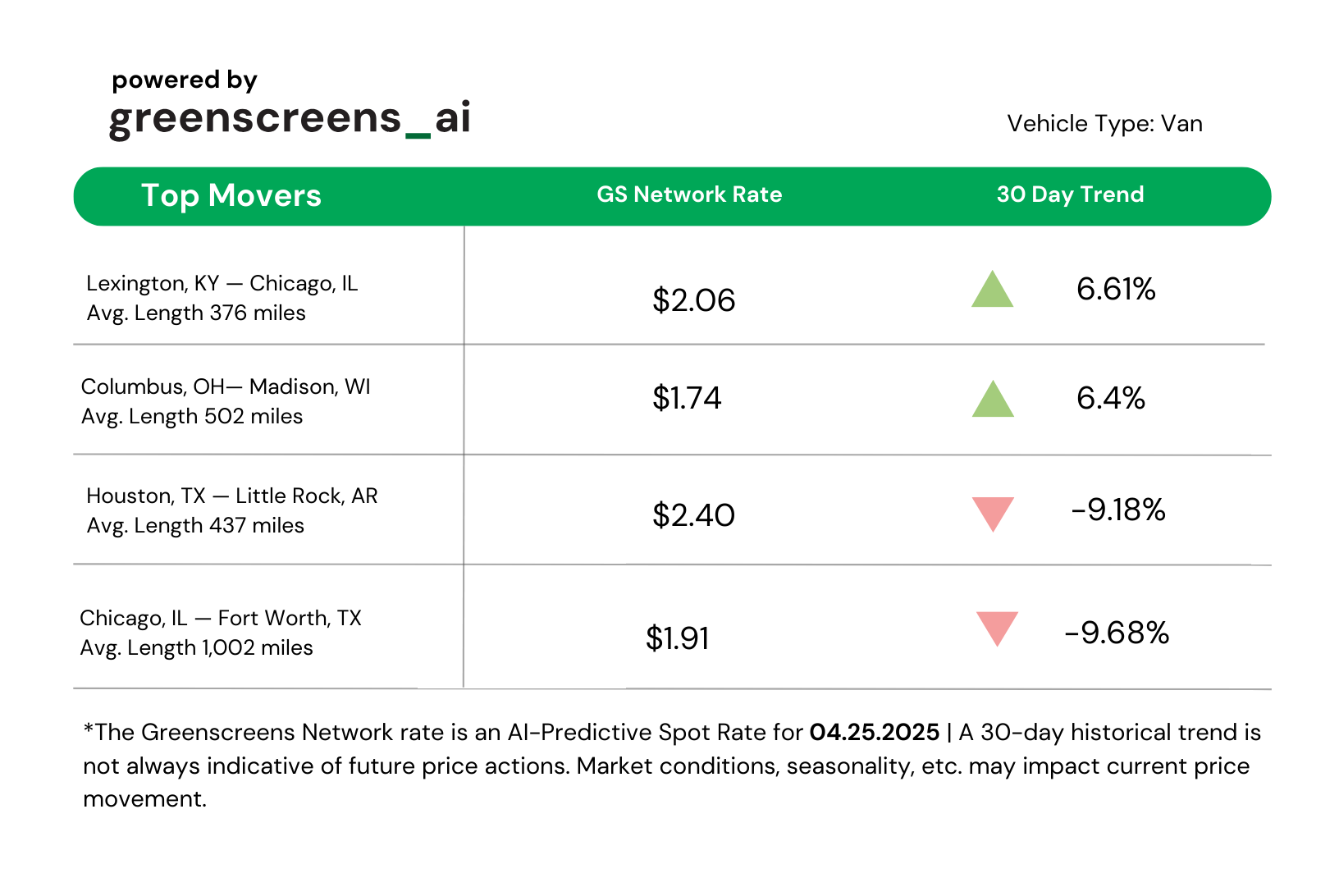
Greenscreens.ai forecasts truckload buy prices tailored to each brokerage using AI and 130+ data points.
🐔 WHAT’S COOKIN’ IN FREIGHT
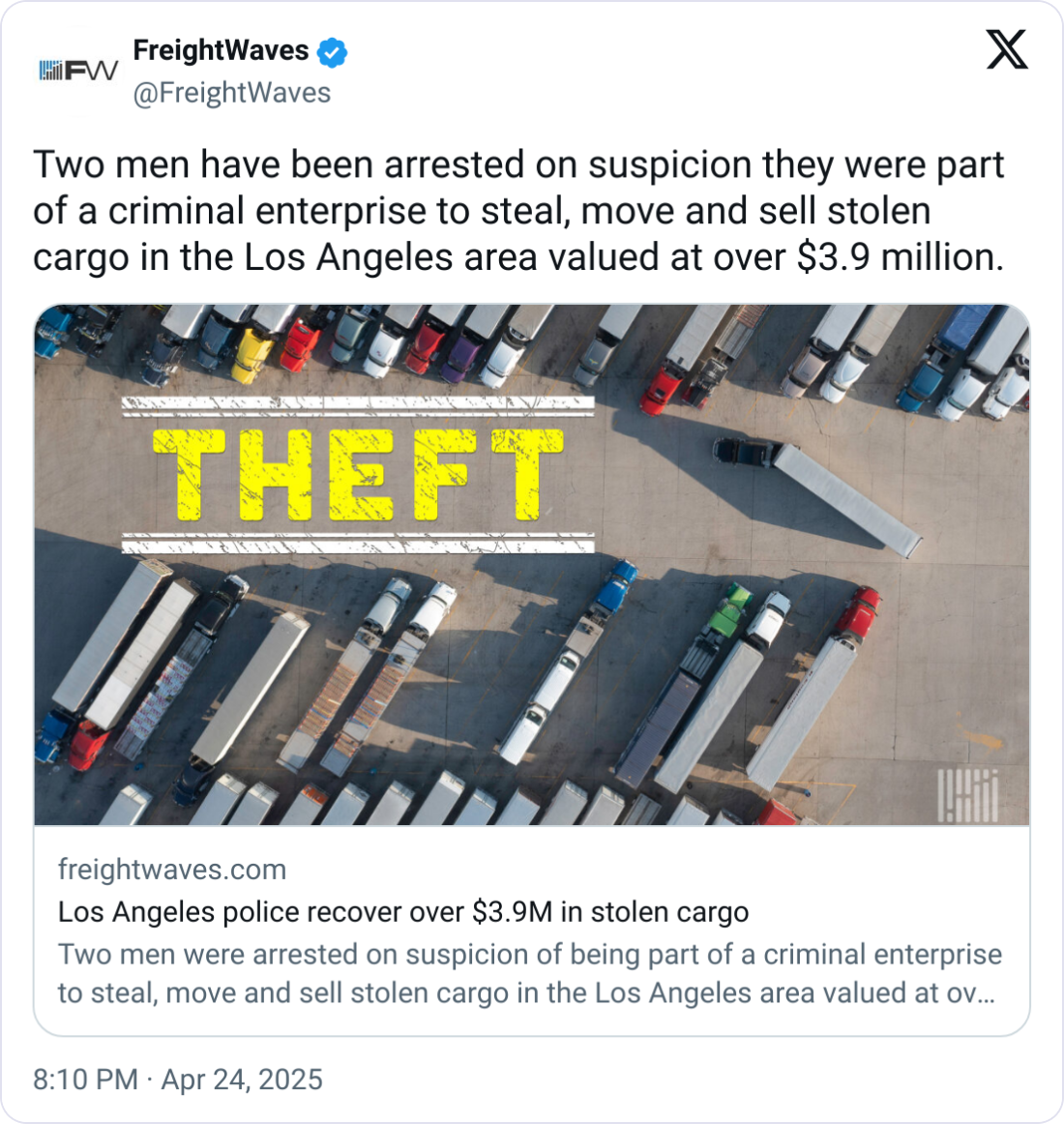
🚓 LAPD Busts $3.9M Cargo Theft Operation Tied to South American Ring. In a major cargo theft sting, the LAPD recovered over $3.9 million in stolen goods—including $2.7 million in bitcoin mining computers and $1.2 million in tequila, coffee, clothing, and other items. The suspects, Oscar David Borrero-Manchola, 41, and Yonaiker Rafael Martinez-Ramos, 25, are described as “prominent members” of the South American Theft Group. They were apprehended following coordinated raids on storage units in the San Fernando Valley; one has been released, while the other is being held on a no-bail warrant. The operation, involving multiple law enforcement agencies, highlights a broader effort to safeguard L.A.’s commercial transport systems, according to a statement released about the case. The investigation remains ongoing, with further arrests anticipated.
📦 Nuvocargo and UPS Accelerate Logistics Expansion Across North America. Nuvocargo has acquired South Carolina-based Merge Transportation, adding intra-U.S. freight services to its AI-powered logistics platform, which spans the U.S., Mexico, and Canada. This acquisition strengthens Nuvocargo’s cross-border capabilities, while its expanding Mexico City office continues to support tech development for complex trade routes. Simultaneously, UPS is boosting its healthcare logistics presence through a $1.6 billion acquisition of Canada’s Andlauer Healthcare Group. The deal enhances UPS’s cold chain infrastructure and supports its goal of reaching $20 billion in healthcare revenue by 2026. Benjamin Gordon praised the move on LinkedIn, stating that it shows U.S. companies are actively engaging in Canadian markets and that “cross-border deals are indeed getting done despite the current trade war.”
🚚 U.S. Eases Path for Autonomous Commercial Trucks. The Trump administration is rolling back regulatory barriers to fast-track autonomous vehicle deployment, with a particular focus on commercial trucking. The NHTSA has announced updates allowing U.S.-made autonomous vehicles to qualify for safety standard exemptions previously limited to imports. While crash reporting is still required, the agency is easing some rules to reduce burdens on manufacturers. Companies like Aurora could benefit from the relaxed regulations as they advance their autonomous trucking initiatives. Some drivers believe Full Self-Driving technology will become mandatory for Class A trucks, with one noting they “can not imagine ever going back to driving without it.” However, critics argue that varying state laws—the“legal red tape”—could hinder widespread adoption. Others raise concerns about cargo theft if autonomous trucks are hacked.
Understanding The Rising Threat of Cargo Theft: What Brokers Need to Know
Cargo theft is becoming increasingly sophisticated, with fraudsters using deceptive tactics to steal freight. High-value commodities like food, electronics, and household goods remain top targets, contributing to an average cargo theft value of $206,000.
Understanding how these schemes unfold—and how to prevent them—is critical to protecting your business. In our latest blog, we break down emerging threats, including FMCSA identity manipulation and VoIP fraud, and share actionable steps to protect your organization.
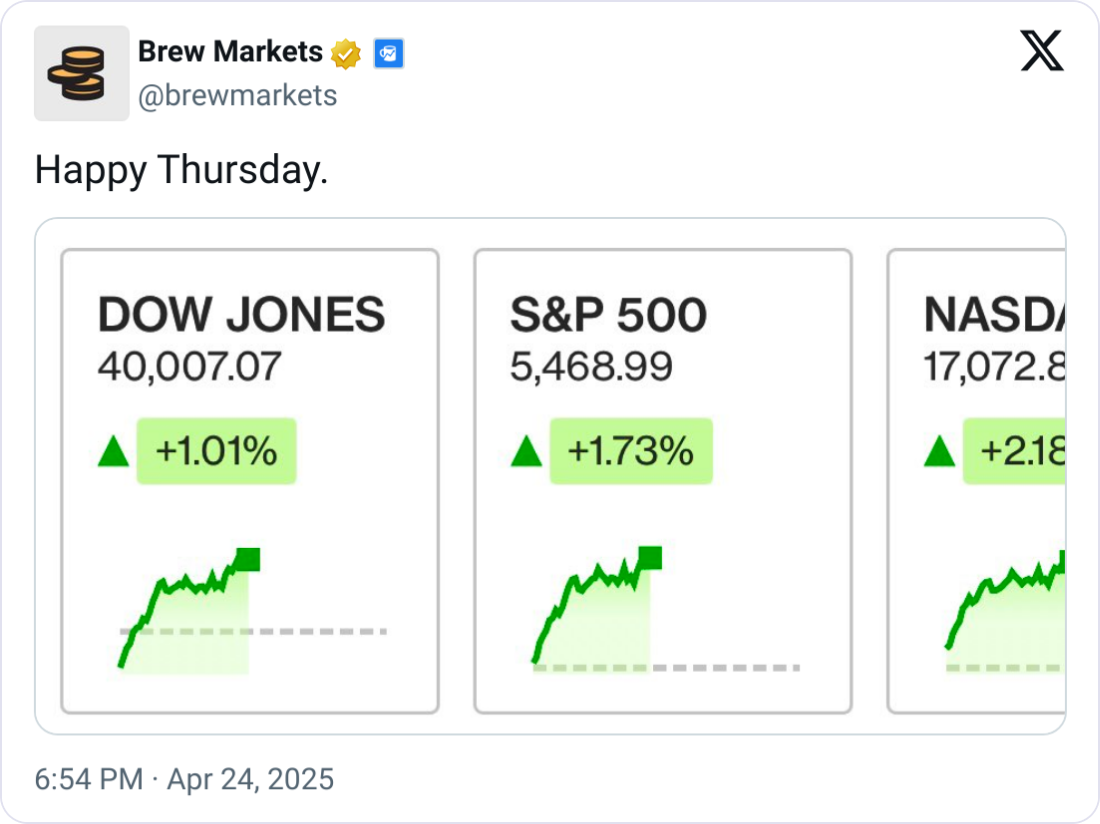
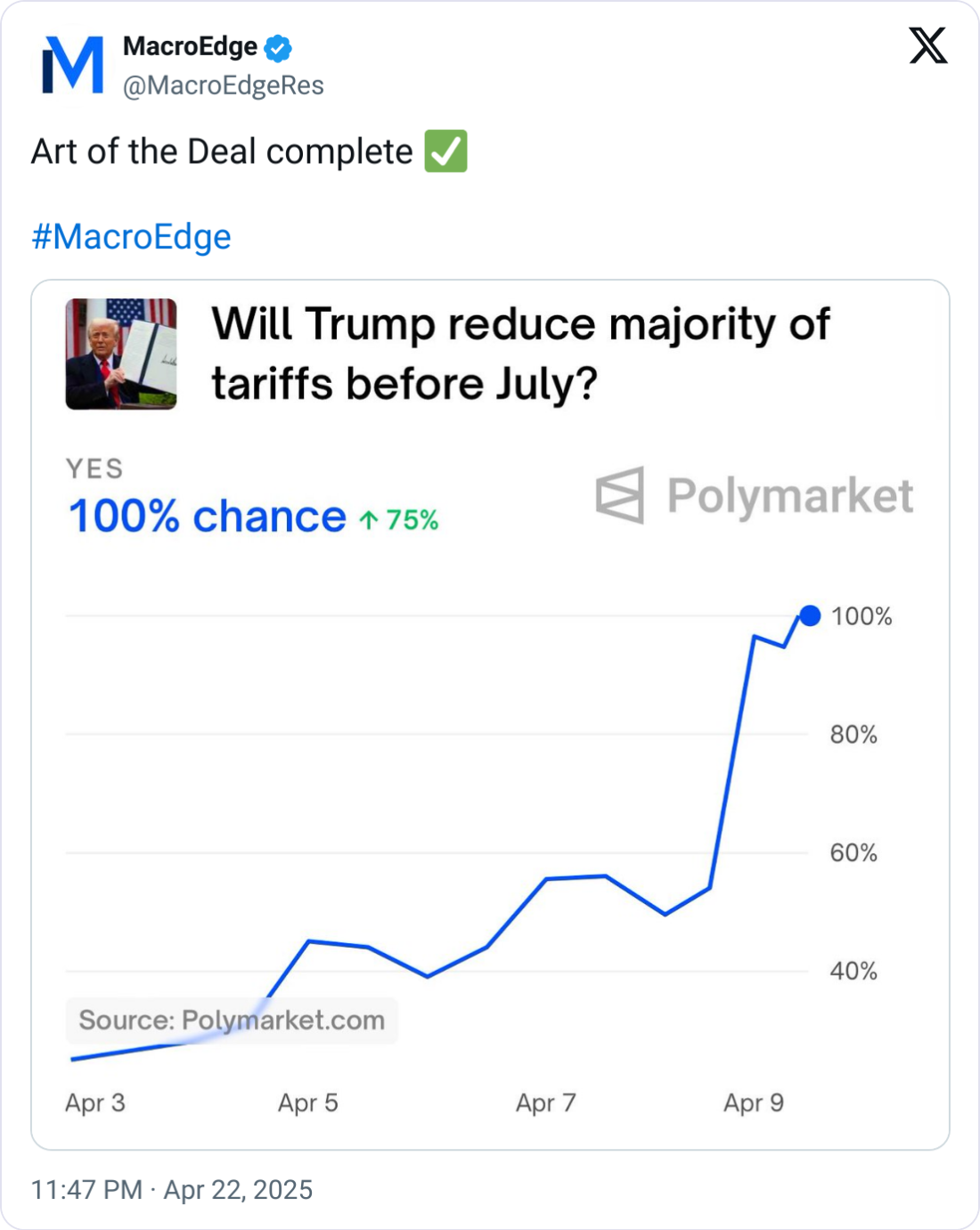
Markets rallied after rumors began to swirl about the potential for tariff de-escalation.
From car parts to coffee beans, the Trump administration’s trade moves continue to set off alarm bells across industries.
As May approaches, companies large and small are scrambling to understand the real-world fallout: higher costs, broken supply chains, delayed freight, legal challenges—and an uneasy feeling that even if tensions cool, the damage might already be done.
Here’s a look at where things stand.
Auto Industry to Trump: “You’re Scrambling Our Supply Chains"
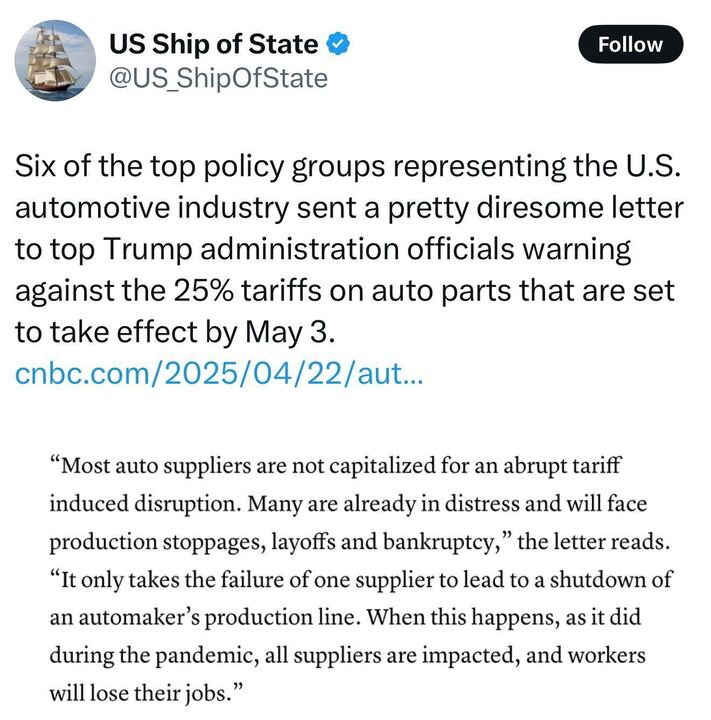
The U.S. automotive sector is firing on all PR cylinders as Trump's trade team steers into a fresh wave of tariffs on imported car parts, slated to begin May 3.
In a signed letter to the Trump administration, six of the nation’s largest automotive trade associations warned the move could stall a $1.2 trillion industry and jeopardize 10 million U.S. jobs.
However, Trump’s team has shown “openness to reconsidering” the parts tariffs. Industry leaders call that “a positive development and welcome relief”—but they’re bracing for impact all the same.
Legal Challenges Mount Against Tariff Policies
A coalition of 12 states has filed a lawsuit against the Trump administration, challenging the legality of the recently imposed tariffs.
The plaintiffs argue that the administration overstepped its authority by enacting tariffs without congressional approval, leading to economic disruptions across various sectors.
Trucking Industry Faces Uncertainty Amid Import Probe
The Trump administration has initiated a national security investigation into imports of medium- and heavy-duty trucks and related parts.
The probe, conducted under Section 232 of the Trade Expansion Act, could lead to new tariffs on these imports, citing concerns over foreign dominance in the sector.
"The Commerce Department will probe the national security risks stemming from a 'small number' of foreign suppliers that it says have dominated U.S. imports in part due to government subsidies and 'predatory trade practices.'"
Tariffs Impact Major Hubs
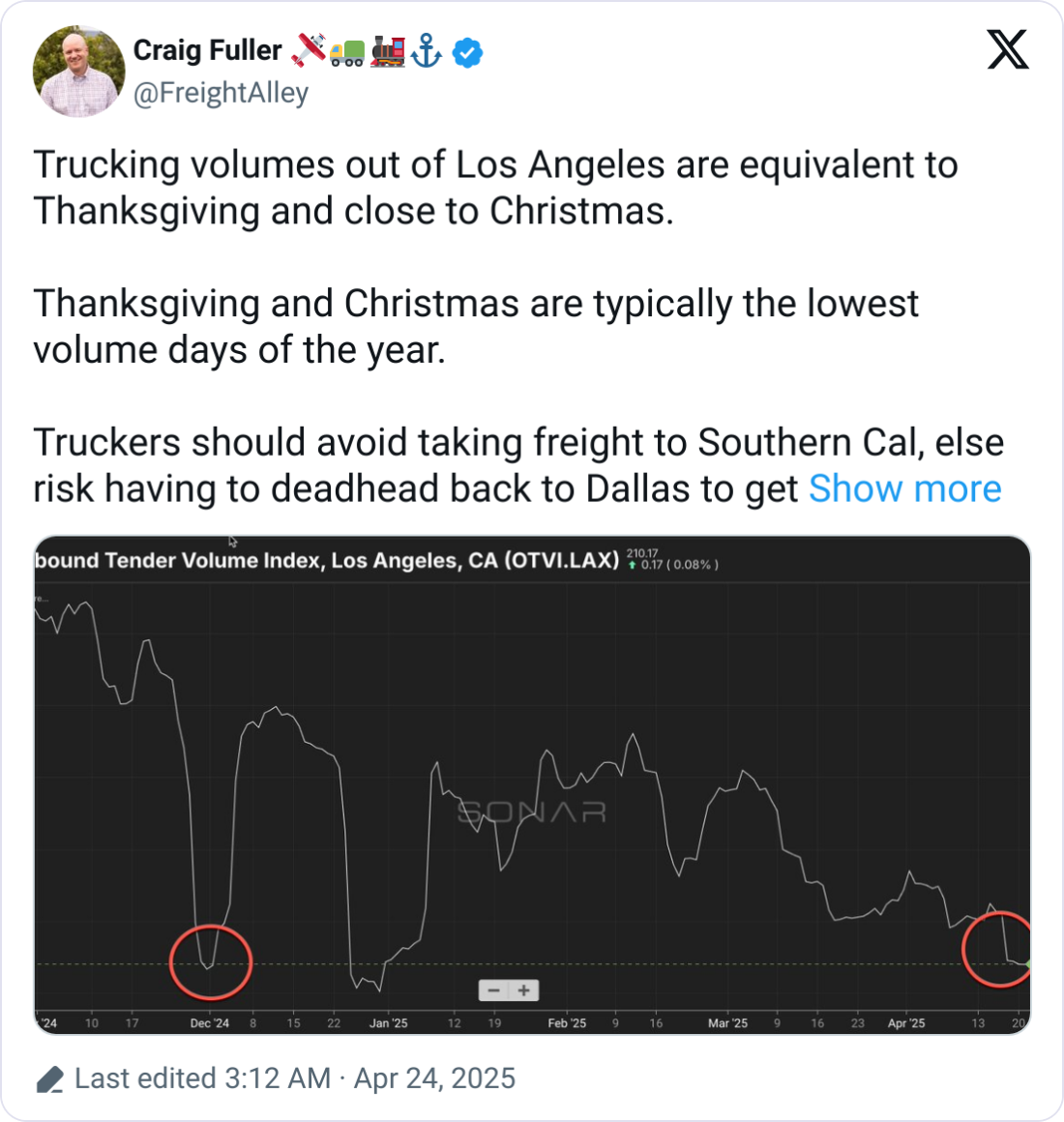
FreightWaves' Craig Fuller advises truckers to avoid SoCal freight to avoid excessive deadhead miles.
The imposition of 145% tariffs on Chinese imports has sent shockwaves through major U.S. logistics hubs, particularly in Southern California.
Ports of Los Angeles and Long Beach, which handle a significant portion of trans-Pacific trade, are experiencing reduced volumes, affecting companies like Amazon, FedEx, and UPS.
Molson Hart, CEO of educational toy company Viahart, broke it down:
"Around April 10th China to USA trade shut down. It takes ~30 days for containers to go from China to LA... that means there are no economic effects of what was done on April 10th until about May 10th."
So, even if tariffs were dropped tomorrow and both sides hugged it out, Hart warns, restarting the flow of goods would take another 30–50 days at best.
U.S.-China Trade Negotiations in Question
Now, conflicting statements from U.S. and Chinese officials have created uncertainty regarding the status of negotiations.
While President Trump has suggested that discussions are ongoing, Chinese authorities have firmlydenied such claims.
"It doesn’t matter who 'they' is. We may reveal it later, but they had meetings this morning, and we've been meeting with China," Trump said.
However, as of writing, news just broke that China has quietly "suspended tariffs on some U.S. semiconductors" and considering lifting tariffs on other goods like medical gear and chemicals. So, maybe there has been some talking after all.
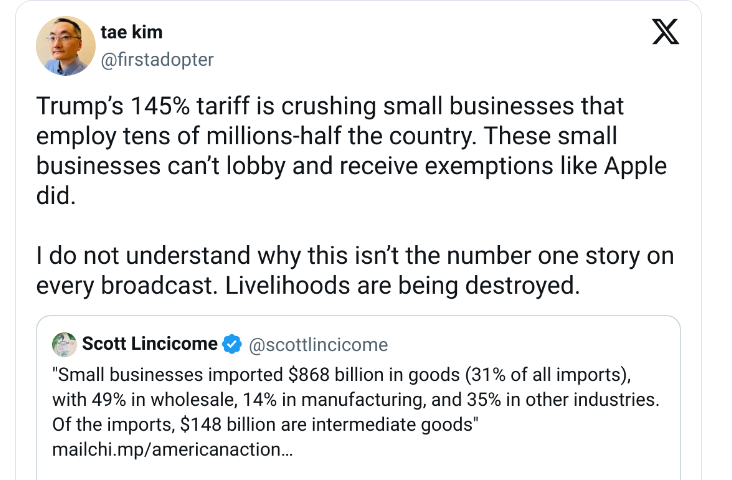
Small Businesses Lost in the Conversation
While major industries scramble for exemptions and legal workarounds, small businesses are watching from the sidelines. Many small e-commerce sellers and independent importers source products or components from China, meaning even slight tariff increases ripple down the supply chain fast.
Kim Benike, co-founder of Busy Baby, a Minnesota-based company specializing in baby products, shared her distress:
"...I am abandoning my products in China. I am leaving them there because I simply cannot afford to ship them here."
Some small businesses have joined forces to crowdsource support by starting petitions to bring attention to their issues, like this one from the company Coffee Bros. requesting the president exempt the coffee industry from tariffs.
Meanwhile, Apple...
To sidestep potential China tariffs, Apple plans to move production of iPhones sold in the U.S. to India by 2026. The company is accelerating talks with Foxconn and Tata to get it done sooner.
Bottom Line
Tariffs may be softening, but the ripple effects are just beginning. From idle ports and scrambling suppliers to small businesses waving the white flag, the damage is real, and recovery won’t be instant, even if negotiations succeed.
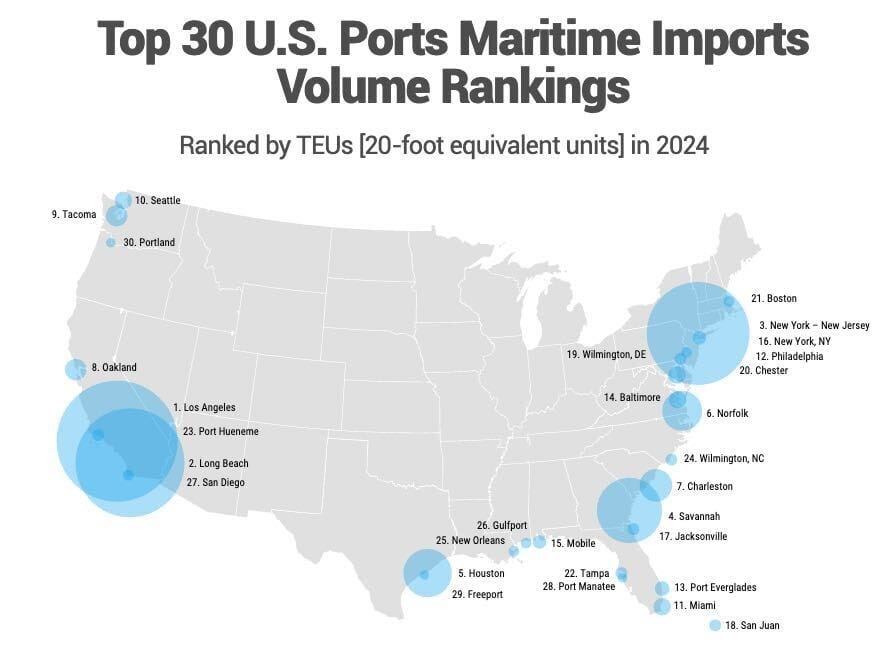
⚓ Top Ports by Volume. Descartes has released its ranking of the Top 30 U.S. Ports by maritime import volume. The Ports of Los Angeles and Long Beach lead the list, followed by New York/Newark, Savannah, GA, and Houston, TX.
🚢 Setting Sail. BYD has launched the world’s largest vehicle cargo ship. The massive vessel measures 219 meters in length and 37.7 meters in width, with the capacity to carry 9,200 vehicles.
📈 Trailer Orders Soar. March saw a striking 63% year-over-year increase in trailer orders. However, Jennifer McNealy, Director of Commercial Vehicles Market Research at ACT, cautions that a single month’s spike doesn’t reverse the trend of generally weak trailer demand.
📊 ATRI’s 2025 Agenda. The American Transportation Research Institute (ATRI) has announced its top research priorities for 2025, focusing on emerging technologies, truck parking, and workforce development across the industry.
🤝 Partner Up. CtrlChain and NewCold are collaborating to develop a fully integrated cold logistics solution. Their partnership aims to build a connected supply chain ecosystem that not only anticipates risks but also enhances demand forecasting and automates operations, according to CtrlChain CEO Giovanni Gubbels.
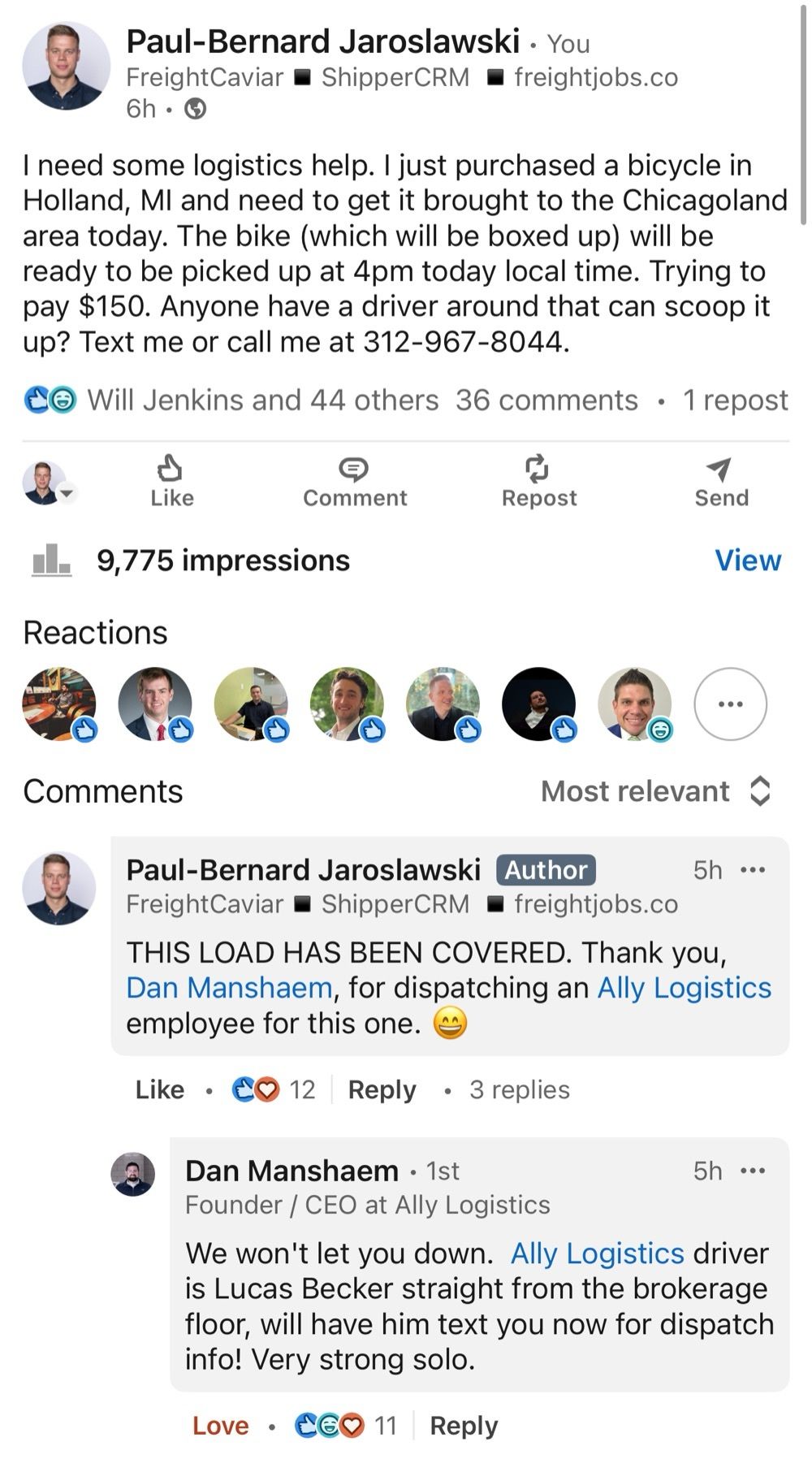
Big thanks to Lucas at Ally Logistics for helping me get my bike from Holland, MI to Des Plaines, IL last Friday. Appreciate the assist from TextLocate, too who helped us track the whole thing in real time. Full recap of the story here.
The FreightCaviar Podcast: In this week’s episode, we sat down with David Bell, Founder and CEO of CloneOps.ai. Catch it on YouTube, Spotify, and Apple Podcasts.
FreightCaviar Forum: Now Live! A space built for brokers, carriers, dispatchers, and freight tech to connect, share, and learn from one another. Sign up now here.
FREIGHT HUMOR
Funny Freight Friday: Check out the funniest emails and screenshots we’ve gotten lately here. Got something hilarious to share? Send it to kaja@freightcaviar.com and you might see it featured next!
I’m Adriana, a writer and editor at FreightCaviar. I’ve covered everything from freight tech to industry lawsuits and market shifts, helping scale us to almost 14K subscribers. My goal: to make logistics stories digestible, clear, and fun to read.
Hello! I'm Jerome FreightCaviar! I’m into the politics of freight and the impact it will have worldwide. I'm always eager to learn more. Follow me on X @JeromeFreightC
Two bills just dropped in the Senate that could reshape trucking faster than anything since deregulation. Plus: Russian hackers targeted your load board, flatbed rejection rates just hit 40%, and a robot is taking the Houston-Dallas overnight run.
This week: The Dalilah Law, a trucking bankruptcy that wiped out thousands overnight, a FreightGuard civil war on Reddit, and the payroll data that's predicting Q4 capacity.
Indiana pulled the trigger on carriers employing illegal CDL holders. Plus: tariff ruling could flood LA with imports, DC finally moves on double brokers, spot rates are outrunning contract, and more.
The Supreme Court ruled Trump's tariffs illegal. Plus: an Illinois official took $300K and handed out illegal CDLs, cartel violence may affect your Mexico freight, 550 CDL schools just got shut down, and more.
Keep up with the freight broker world in 5 minutes.
Join over 14K+ subscribers to get the latest freight news and entertainment directly in your inbox for free. Subscribe & be sure to check your inbox to confirm (and your spam folder just in case).