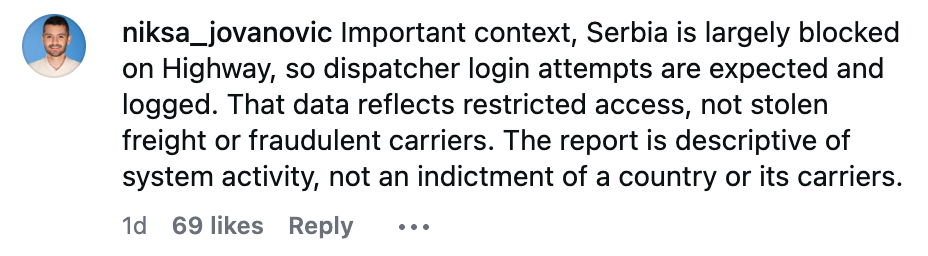
Last week, Highwayreleased its Q4 2025 Freight Fraud Trends Report. The report outlined the countries outside the U.S. most frequently associated with freight fraud.
According to the report, the top three countries in 2025 were:
Serbia
India
Lithuania
This marked a shift from 2024, when the top three were India, Mexico, and Pakistan.
Highway's latest data shows the top countries tied to U.S. freight fraud in 2025 were:
We shared this data on Instagram as a carousel highlighting Serbia’s placement in the top three. While the information itself didn’t surprise many industry insiders, it did prompt strong reactions, particularly given FreightCaviar's sizable Serbian audience.
I’ve personally visited Serbia three times, and we’ve published multiple videos from those trips.
Before going any further, it’s important to clear up a key point:
There are many legitimate Serbian carriers, dispatchers, and brokers operating professionally and legally, doing solid work and not involved in freight fraud. Data like this reflects patterns identified by Highway, not a judgment on an entire country or its people.
After the post went live, we saw comments suggesting other countries, Uzbekistan, Moldova, Ukraine, and others, should have appeared instead.
To better understand how Highway compiles and interprets this data, we spoke directly with Demi Ramon, VP of Operations at Highway, to clarify what the report measures and why those specific countries appeared in the rankings.
What Highway is actually measuring (and what it’s not)
First, a quick clarification: this report isn’t a “country reputation score.” It’s not a statement that people from X country are bad.
It’s Highway’s view of risk signals they’re detecting inside their platform, based on what they see tied to fraud patterns and theft activity.
When we asked Demi Ramon how these rankings are determined, she said it comes down to:
User activity + anomalies they see across their system
Theft events and fraud behavior patterns that correlate with those anomalies
A country-level view of where those risk signals are showing up the most
And one detail that matters here: she also said Highway can differentiate location signals even when bad actors try to hide behind VPNs.
So when people comment “it’s actually Uzbekistan” or “it’s actually Moldova” or “it’s actually Ukraine,” Highway’s position is basically: we can often tell where the user is truly operating from, versus where they’re pretending to be.
That doesn’t mean other countries aren’t involved; it just means this particular report is based on what their platform is observing and attributing at scale.
You can catch what Demi Ramon had to say during yesterday’s interview, starting at around the 1-hour-30-minute mark:
To conclude, this aligns with what I’ve heard firsthand during my trips.
Like in many parts of the world, there are isolated pockets of organized, shady behavior that intersect with U.S. trucking and logistics operations. That reality exists, whether people want to acknowledge it or not.
At the same time, and this matters, I want to be crystal clear: the vast majority of people I know in Serbia are hardworking, ethical, and doing things the right way.
They’re building legitimate businesses, supporting U.S. freight operations, and contributing positively to the industry.
Ironically, that makes sense. the good Serbs can spot the fraudsters Serbs from a mile away.
This data is not an indictment of a country or its people. It’s a snapshot of where risk is currently showing up, and why separating bad actors from good operators is more important than ever.
Check out our previously filmed content from Serbia:
Keep up with the freight broker world in 5 minutes.
Join over 14K+ subscribers to get the latest freight news and entertainment directly in your inbox for free. Subscribe & be sure to check your inbox to confirm (and your spam folder just in case).