Cargo Theft: Why Drivers Aren’t the Weak Link – The System Is

For a long time, secure parking lived in the “nice-to-have” bucket. That framing no longer works. In today’s environment, secure parking functions as a preventative security layer.

Cargo Theft: Why Drivers Aren’t the Weak Link – The System Is

Cargo theft is often framed as a moving problem. Hijackings. Fake pickups. Double-brokering scams. Drivers getting hit mid-route. 

But this has shifted to something more subtle and more dangerous. 

Cargo theft happens when freight is forced to stop. 

Yet the industry is still treating parking like an afterthought. 

The Hidden Pattern Behind Rising Cargo Theft

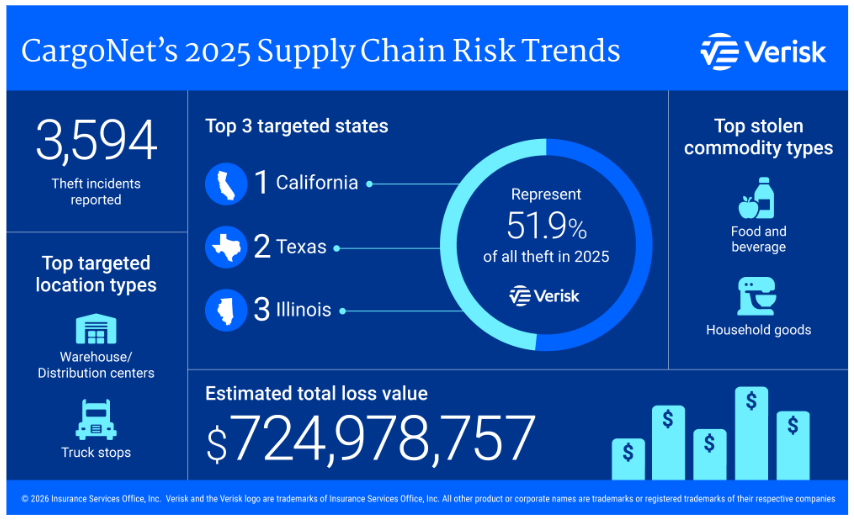
Warehouses, DCs, and truck stops consistently top the chart of targeted location types for cargo theft according to data from CargoNet.

Talk to almost anyone in freight right now — a driver, a dispatcher, a broker — and they’ll tell you the same thing: theft is getting smarter.

What doesn’t get discussed enough is where these thefts are increasingly happening.

Not on open highways.Not during dramatic chases.But at predictable pauses in the system:

  • overnight rest periods
  • congested metro corridors
  • overflow truck stops
  • unsecured drop-and-hook locations
  • last-minute parking decisions forced by hours-of-service limits

It’s simple pattern recognition.

Organized theft rings have learned this: freight stoppage is the most vulnerable moment in the journey.

And in the U.S., those moments are becoming more frequent.

How Regulation and Reality Collide at the Curb

Drivers don’t stop because they want to. They stop because they have to.

Hours-of-service regulations enforced by FMCSA are designed for safety — and rightly so. But they also create hard deadlines in a system that hasn’t kept pace with infrastructure.

The result?

  • Parking fills up earlier than expected
  • Legal options disappear quickly
  • Drivers are forced to choose between:
    • risky locations
    • unauthorized parking
    • or driving longer to find space

Each of those choices creates exposure for the driver, the cargo, the carrier, the broker, and ultimately the shipper.

This is how regulation unintentionally turns parking into a security problem.

Why Traditional Anti-Theft Tools Keep Missing the Moment

The freight industry hasn’t been asleep at the wheel on theft. Far from it.

Companies have invested heavily in:

  • GPS tracking
  • telematics
  • cameras
  • alerts
  • insurance coverage
  • post-event claims workflows

But here’s the uncomfortable truth: most theft tools activate after risk is already present.

  • Tracking tells you where freight is — not whether it’s safe to be there.
  • Cameras record what happened — they don’t stop it.
  • Insurance helps recover losses — not prevent them.

In other words, much of the industry’s anti-theft stack is reactive.

What’s missing is control before the truck stops.

Secure Parking Isn’t a Convenience Feature Anymore

For a long time, secure parking lived in the “nice-to-have” bucket.

Something drivers appreciated. Something operations teams rarely planned around. Something treated as logistics friction rather than risk control.

That framing no longer works.

In today’s environment, secure parking functions as a preventative security layer.

The difference between a known, vetted, access-controlled location and an improvised stop based on what’s left is often the difference between a clean delivery and a six-figure loss.

This is why secure parking has quietly become one of the most underutilized theft prevention tools in the U.S. freight market.

CtrlChain’s Answer to the Parking Problem: Smart Secure Parking

If reversing the cargo-theft curve starts with removing opportunity, the newest innovation from CtrlChain builds directly on that idea by preventing vulnerable stops from ever occurring

The Smart Secure Parking feature turns what was once an informal, decentralized decision into a planned, visible, and enforceable part of freight execution: 

Teams define security expectations before the truck ever moves. Secure-parking requirements can be set at booking, tied directly to the load, and adjusted if plans change, removing the guesswork that often leads to risky last-minute stops.

Once a load is in motion, routes are dynamically calculated with approved parking locations and required break times in mind. Only those approved parking lots are surfaced to the carrier, ensuring stops align with predefined security expectations. If a truck stops outside those approved locations, the system flags it in real time, giving operations teams visibility while risk is still unfolding, not after the fact.

At a glance, the feature enables:

  • Upfront parking rules tied to each load
  • Live visibility into approved vs. unapproved stops
  • Automated alerts when a vehicle remains stationary in a risky location
  • A single source of truth for parking compliance and review

Rather than reacting to theft after it happens, CtrlChain embeds prevention into the workflow itself, making secure parking a control point. 

The Bigger Takeaway

Cargo theft hasn’t become more random. It’s become more patient.

By operationalizing secure parking inside the execution layer, CtrlChain addresses one of the most overlooked vulnerabilities in U.S. freight today.

Because the future of theft prevention isn’t just knowing where freight is moving.

It’s controlling what happens when it stops.

See how CtrlChain turns secure parking from an afterthought into a built-in control point across the shipment lifecycle.


Great! You’ve successfully signed up.

Welcome back! You've successfully signed in.

You've successfully subscribed to FreightCaviar.

Success! Check your email for magic link to sign-in.

Success! Your billing info has been updated.

Your billing was not updated.