The March LMI reads like 2022 with prices at a 4-year high.
Plus: warehouse arson in California, Mexico's trucker strike enters day three, and broker margins are still underwater.
Freight Dreams in the Fog: Inside San Francisco’s AI Freight Rush
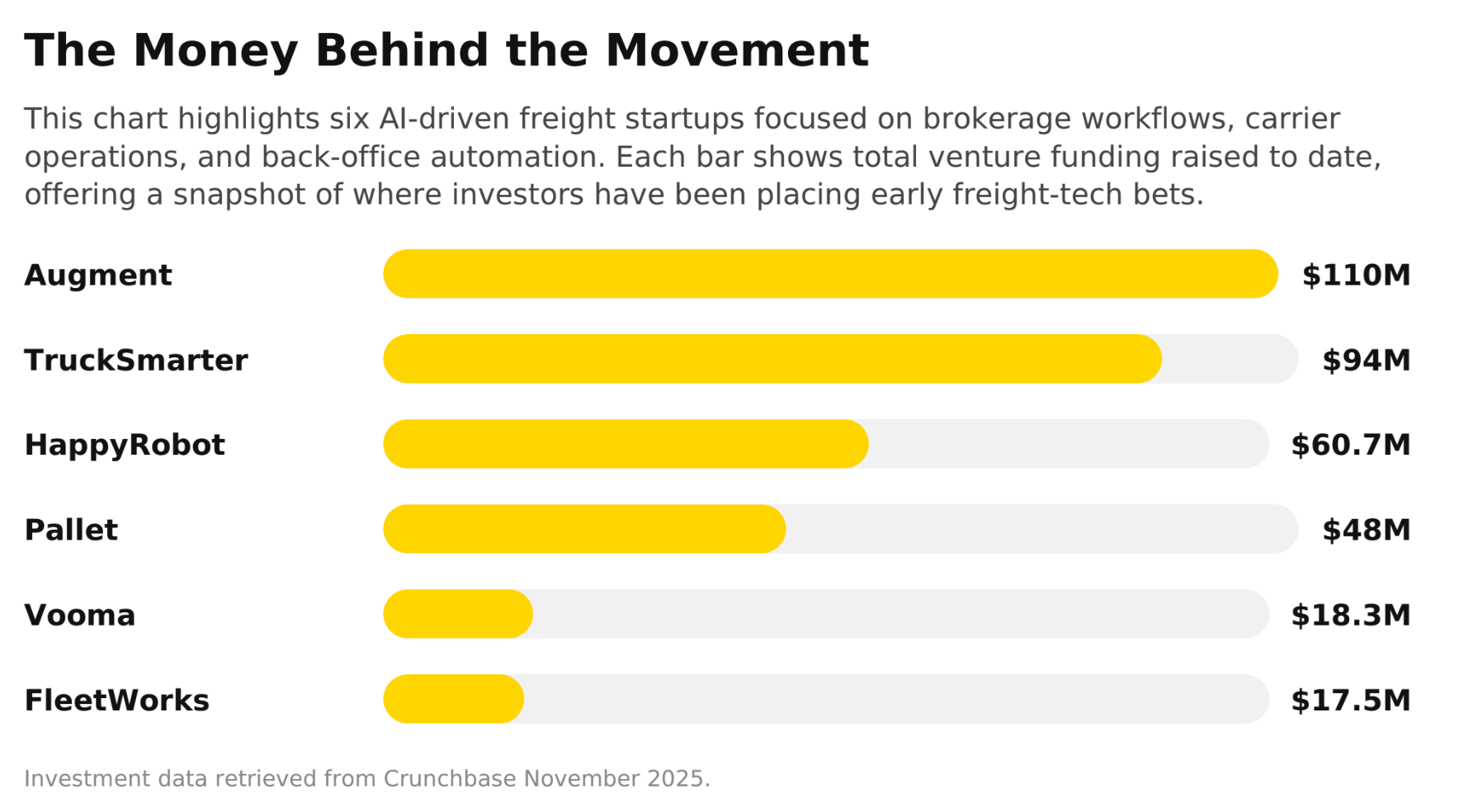
Our trip to San Francisco started with a DM. TruckSmarter’s CEO, Daniel Kao, asked us to partner on their biggest launch yet, a driver-first product backed by $16M in fresh investment.
From left to right: Will Jenkins (Journey), Bogdan Kruzhinskiy (Moon Express), Paul-Bernard Jaroslawski (FreightCaviar), Patryk Słowik, Dan Khao (TruckSmarter), and Krystian Gebis (Shipper CRM) in San Francisco - July 2025. Photo: Dariusz Remis
This feature first appeared in our inaugural FreightCaviar print magazine. Subscribe here.
Our trip to San Francisco started with a DM. TruckSmarter’s CEO, Daniel Kao, asked us to partner on their biggest launch yet, a driver-first product backed by $16M in fresh investment. So we packed our cameras, landed in a city where optimism is a birthright, and stepped into a week of interviews, demos, and whiteboards filled with one recurring word: AI.
If you’ve worked in freight long enough, you’ve heard “we’re going to fix it” more times than you’ve had check calls. This time feels different, and yet familiar. Leaner teams. Better math. And a city that still believes great software can bend reality.
We filmed a documentary about that belief. This feature is the texture, the color, the argument for why you should watch the film and decide for yourself whether this is a boom… or the opening credits of another bubble.
The Freight AI Gold Rush
By 2025, capital drifted back into freight tech, but with new rules.
Investors weren’t chasing shiny ideas anymore; they were looking for tools that actually do work. And AI fit neatly into that shift. Freight is a business built on tasks: calls, quotes, check-ins, documents, exceptions. If software can take those on, the math starts to change.
It’s a perfect setup for AI. Calls made, documents processed, appointments scheduled, exceptions resolved; these are discrete, billable units of work that map to freight’s volatility.
So we want to know the answer to the only question that matters:
Does it move the load? We spent a week testing the question across the team’s building the next generation of freight tech.
The Players We Met
TruckSmarter: “Let drivers drive.”If brokers get a thousand emails, drivers get a thousand headaches. Clear those up and freight moves.
TruckSmarter began as a free load board. Today it looks like a driver operating system, now with an AI Dispatch that calls brokers, verifies details, filters junk, and kills time-wasters before a driver loses hours. One line from Kao stuck with us:
“Five percent of our calls are AI to AI… and the robots get along great.”
It’s funny, but it’s also throughput math: fewer dead calls, fewer missed loads.
In November, TruckSmarter announced a long-term partnership with OTR Solutions that transitions its factoring division to OTR while Trucksmarter doubles down on AI-driven dispatch and load board tech. That split makes sense: faster, more reliable pay on one hand, faster load discovery on the other.
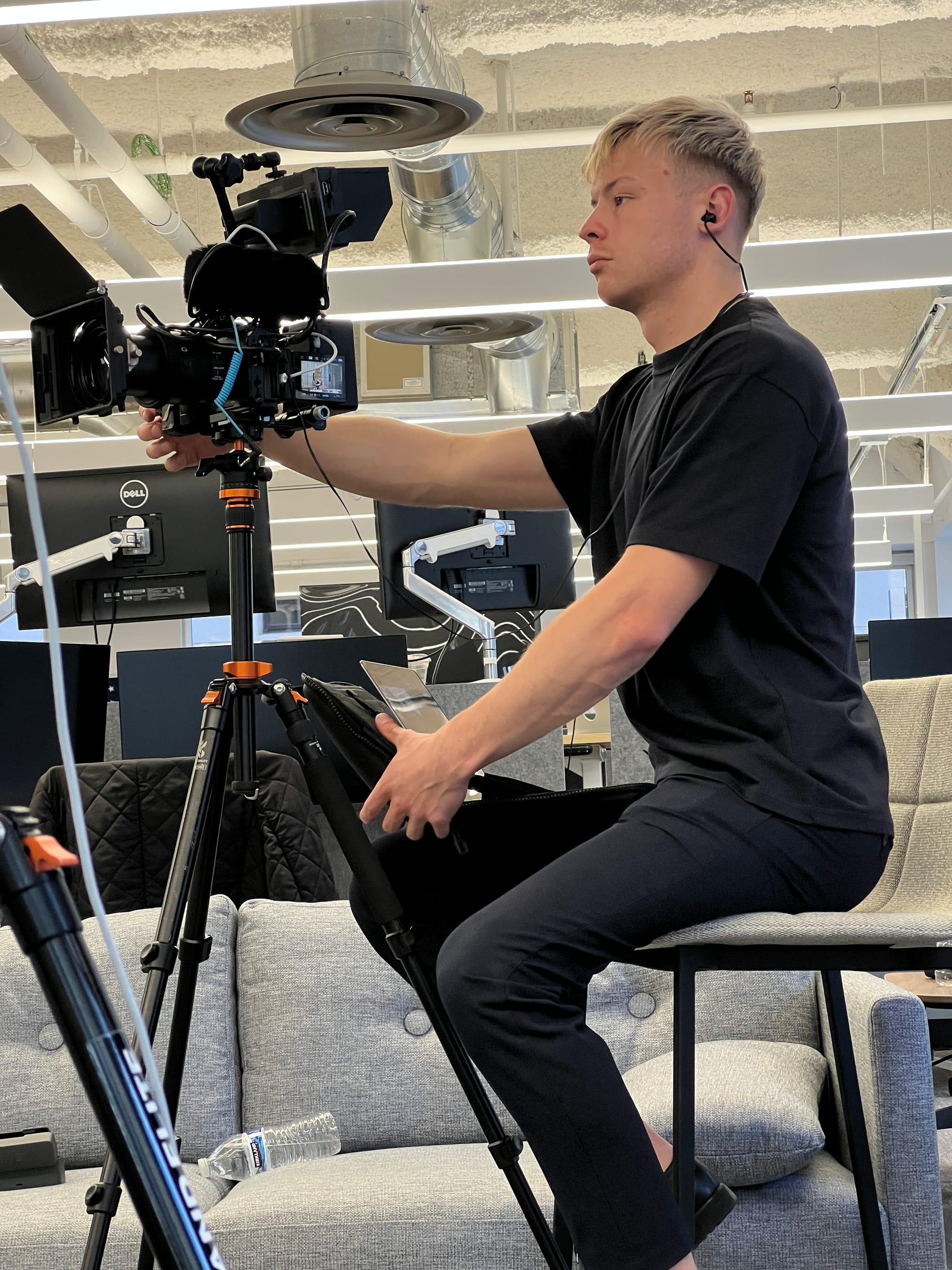
Patryk Słowik, one of our videographers, behind the scenes capturing moments at the TruckSmarter HQ in San Francisco.
Kao sees SF clearly: “What makes this region special is the default that anything is possible. You just have to figure it out.” That tension shows up everywhere in this story.TruckSmarter’s pitch is more loads moved with fewer wasted conversations. Exactly what AI should be doing.
HappyRobot: Voice agents with a freight brain.
If AI can follow SOPs, handle the busywork, and stay calm under pressure, humans get their time back. Freight moves.
Co-Founders Pablo and Javier Palafox, and Luis Paarup were unusually candid for a hyper-growth AI startup. HappyRobot isn’t building “assistants.” They’re building workers: AI agents that handle the calls, follow-ups, and document chases that drain ops teams.
Some customers already run 10–20K calls per day through the system and their Bridge interface lets ops leaders see exactly what each agent is doing in real time, who’s negotiating, who’s escalating, and who’s waiting on approval.
As they framed it to us: HappyRobot is “the platform to build AI workers for supply chain,” with the long-term goal of becoming the central AI workforce across voice, email, text, and Slack.
The best description HappyRobot gave us: “A B+ player with an AI teammate can perform like an A+ player.”
And in freight, that performance delta is everything.
Vooma: From inbox pain to end-to-end agents.
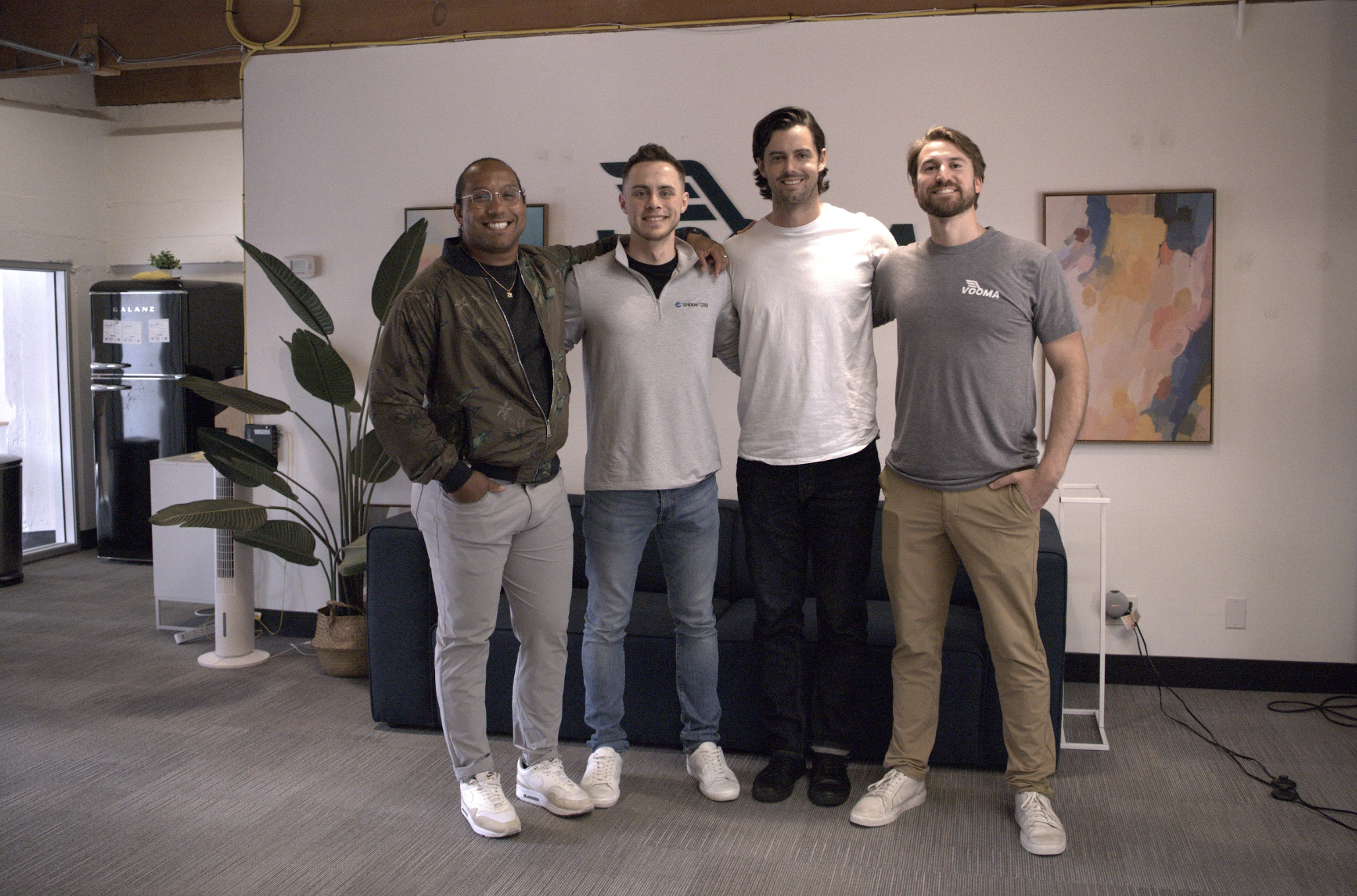
Will Jenkins (Journey), Krystian Gebis (Shipper CRM), Jesse Buckingham & Mike Carter (Co-Founder's of Vooma) at the Vooma HQ in San Francisco.
“Brokers live and die in their inboxes. It’s where quotes are won or lost.”
We met with Co-Founders Jesse Buckingham and Mike Carter, who started Vooma by attacking the part of brokerage everyone hates: turning messy inbound emails into structured orders without hours of manual data entry. That single workflow is where most brokerages quietly bleed time and freight momentum.
Their prediction: within a couple of years, far less human-to-human comms in freight, because AI will represent stakeholders on all sides and handle most back-and-forth.
“We’re not trying to replace decision-making. We’re replacing the 90% of email work that isn’t decision-making.”
Every minute removed from inbox ping-pong goes back into freight velocity. Does it move the load? Absolutely.
Pallet: The last-mile problem of AI
Some teams in San Francisco pitch AI agents like they’re magic. Sushanth Raman and Andrew Geisse don’t. Their stance is sharper: logistics tech companies fail because operations are too nuanced for shallow automation. Freight dies in the details.
We asked our question: Does it move the load?Pallet framed the answer around accuracy, not hype.
As Raman said:
“If the agent misses a charge and your team has to redo the work, they’ll say: ‘Why did we buy this agent?’”
That line shows why their work matters. “If the agent misses one detail, one accessorial, the human has to redo the whole thing. That’s the part we obsess over.”
Pallet encodes a customer’s genuine SOP, the messy rules operators actually use, directly into the agent. They even built a multi-model consensus layer to reduce hallucinations.
Encoded freight is freight that moves.
FleetWorks: Building the “Super Carrier Rep”
Freight moves when humans focus on the right 20% of work, not the noise. Fleetworks is trying to automate the noise. If there was one pattern we saw again and again in San Francisco, it’s this: the best AI teams aren’t trying to delete jobs — they’re trying to delete busywork.
FleetWorks Founder Paul Singer put it plainly in our interview: brokers aren’t going away, but their day-to-day reality is about to change.FleetWorks began by automating outbound carrier sales. Then they expanded into an AI “always-on dispatcher,” surfacing vetted loads, managing detention, and keeping drivers moving without requiring human coverage on every detail.
“A broker today might manage ten thousand relationships. With AI, why not a million?”
Automation, in his view, is not about fewer people.
It’s about more loads per person.
The Voices in the Middle
Bill Driegert – Freight’s Reality Check
Every story needs a skeptic with receipts. In this one, it’s Bill Driegert.
Driegert’s arc runs through Coyote, Amazon, Uber Freight, and the post-shutdown ConvoyPlatform rebuild. His take: the tech wasn’t the problem, the math was. TAM inflation, misunderstanding gross vs. net revenue, scaling ahead of margins.“You can’t out-run the fundamentals of trucking. Eventually you meet gravity.”
He brings nuance to the AI discourse too: much of what startups claim as “AI breakthroughs” Convoy already automated with app-centric flows years ago, he told us. So don’t slap AI on old processes; re-engineer the work.
Follow the Money: The Dynamo Effect
If anyone has seen freight hype cycles without flinching, it’s Santosh Sankar of Dynamo Ventures. His view of this era is less about AI magic and more about discipline finally catching up with ambition. Sankar hammered home three points:
Great freight startups start with hair-on-fire problems.
Founders need earned insight, not just theoretical knowledge.
Usage-based AI finally aligns with broker reality.
Sankar was also candid about the rising buyer fatigue in this market. Too many teams pitch the same AI wrapper around the same feature. His guidance: be transparent (customers should know when they’re talking to an AI, not a person) and solve something that’s top-three painful.Dynamo’s worldview boils down to this: build for real operational pain, prove the work, and let usage determine value. If the AI doesn’t move the load, it doesn’t deserve a line on the invoice.
The Elephant-Sized Bubble In The Room
Are we in a bubble? Maybe. The better question: what’s different this time? Every founder we spoke to in San Francisco was aware of the tension: freight has seen booms, busts, and a whole generation of “revolutionary platforms” that didn’t survive the math. Surprisingly, a lot is different, according to the people building the tools.
But there are warning signs too, and Driegert was the clearest voice on this. “Trucking is not a neat, clean marketplace. It’s full of constraints — and every constraint breaks your perfect model.” AI won’t save a broken model.
But he still says this is something new: “AI is great at tasks. Freight is built on tasks. That’s why this moment is different. The tech finally maps to the work.”
Behind the Scenes
San Francisco hits different when you’re talking freight tech. We kept running into the same energy: founders who are bright-eyed, opinionated, and deeply convinced they’re building the future.
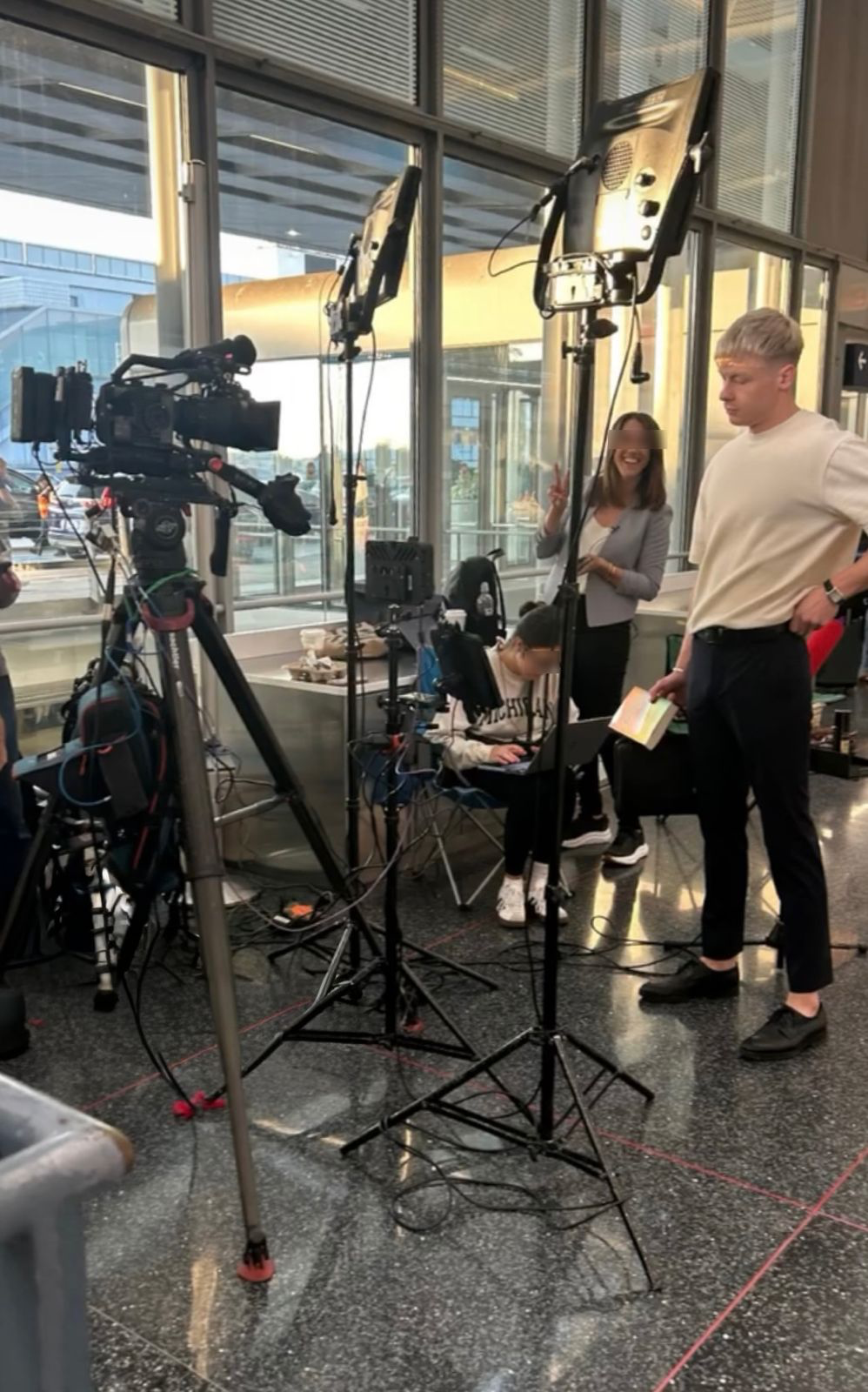
We’ve captured the quiet, obsessive nature of the freight tech founder that normally only shows up in off-camera conversations. We captured the details you won’t find in press releases: the way every founder carried some scar tissue from real freight pain and still believed AI could finally take the sting out of the ugly work.If you want to see those moments, be sure to watch.
More about Patryk Słowik
Patryk Słowik is an international visual director and premium photographer whose work in the United States includes collaborations with some of the world’s largest logistics companies (from San Francisco, through Chicago and Denver, Colorado, to Las Vegas) on projects of global significance.
I’m Adriana, a writer and editor at FreightCaviar. I’ve covered everything from freight tech to industry lawsuits and market shifts, helping scale us to almost 14K subscribers. My goal: to make logistics stories digestible, clear, and fun to read.
Most freight AI pilots work. Most enterprise rollouts don't. Here's what's actually breaking down and what production-grade AI infrastructure looks like in freight.
A practical look at how freight AI is evolving from simple automation to operational decision support, and what it means for broker productivity, tribal knowledge capture, and more.
Keep up with the freight broker world in 5 minutes.
Join over 14K+ subscribers to get the latest freight news and entertainment directly in your inbox for free. Subscribe & be sure to check your inbox to confirm (and your spam folder just in case).