Scaling AI in Freight: Here's Why Enterprise Rollouts Fail After the Pilot
Most freight AI pilots work. Most enterprise rollouts don't. Here's what's actually breaking down and what production-grade AI infrastructure looks like in freight.

The freight industry's AI conversation has moved on from asking whether AI can work in freight to why so few companies can actually run it at scale.
C.H. Robinson processes 37 million shipments a year with 30+ AI agents completing over 3 million shipping tasks. Uber Freight has pushed more than $1.6 billion in freight through AI infrastructure. Both companies are running AI in production, not in a sandbox, not in a pilot, across millions of transactions annually.
Most brokerages and 3PLs are not. And the gap is widening fast.
Across industries, 95% of enterprise AI pilots fail to deliver measurable P&L impact, not because the models don't work, but because the infrastructure around them doesn't. Only about one in three AI prototypes ever makes it into production.
In freight, the stakes for staying stuck are no longer abstract. The margin math is brutal:
The freight brokerage industry stands at a critical inflection point. Adaptability is a survival imperative. Every manual process that AI could handle is now a direct margin leak.
The failure points are rarely technical. They are organizational and structural.
Only 23% of supply chain organizations have a formal AI strategy, most pursue project-by-project wins that produce a tangle of disconnected tools rather than a scalable system. Gartner predicts 60% of supply chain digital adoption efforts will fail to deliver promised value by 2028, largely due to insufficient change management and learning investment.
Here's where enterprise AI rollouts typically break down in freight:
1. Governance without structure. Who owns the AI output when it's wrong? Who updates the model when market conditions shift? Without clear ownership, accountability falls into a gap between IT and operations. Tariff changes, rate spikes, and disruptions like the FMCSA's non-domiciled CDL rule, which could pull up to 200,000 drivers from the market, can instantly invalidate models that no one is actively monitoring.
2. Data that isn't production-ready. The average logistics organization utilizes only 23% of its available data for AI applications, with the remainder locked in legacy systems or suffering from quality issues. A pilot can run on clean, curated data. Production runs on messy reality like emails, PDFs, carrier texts, load board pulls, and TMS exports that don't speak the same language.
3. Integration debt. An AI pilot lives in isolation. In production, it must connect to your TMS, carrier portals, rating APIs, EDI systems, and live transaction flows simultaneously. Gartner found 62% of supply chain AI initiatives exceed budgets by an average of 45%, almost entirely due to unforeseen data and integration complexity.
4. No operational visibility. You can't manage what you can't see. Without real-time monitoring of what AI is doing, what it's getting wrong, and where humans are still filling gaps, scaling becomes guesswork. McKinsey found that workflow redesign is the single biggest driver of business impact from generative AI.
For brokerages operating in the U.S.-Mexico-Canada corridor, the scaling challenge is compounded by one of the most volatile compliance environments in decades.
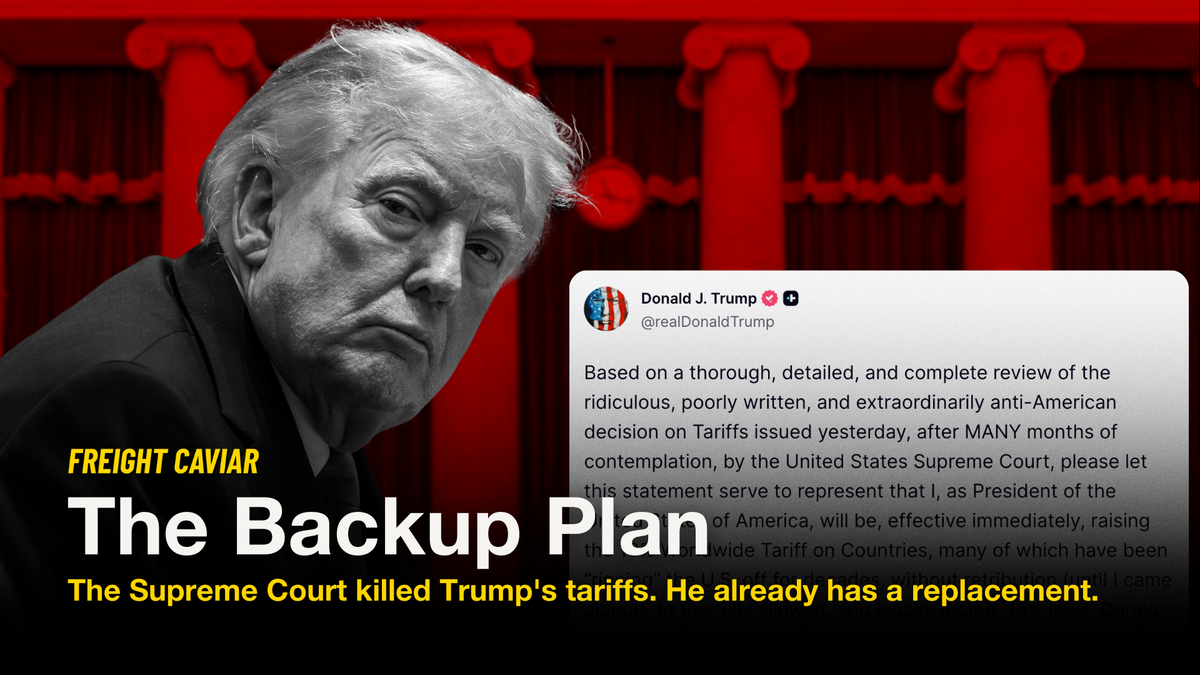
Mexico overhauled its customs tariff schedule on January 1, 2026, raising duties on over 1,400 tariff codes. The U.S. Supreme Court struck down IEEPA tariffs in February 2026, sending trade compliance teams scrambling. Canada's CARM portal continues to generate shipment backlogs. And the USMCA comes up for formal review in July 2026.

Tariff noise is expected to stay loud throughout 2026. Three customs agencies. Three documentation frameworks. Shifting HS codes and rules of origin. A brokerage running cross-border freight on manual processes is also a compliance liability.
AI that is properly governed and connected to live regulatory data can standardize this complexity at scale. AI that isn't will make the same errors faster.
Scaling AI is about building the infrastructure to run AI reliably across millions of transactions per year. That means:
The brokerages pulling ahead got there because they rebuilt the operational infrastructure around their AI tools. Echo Global Logistics reported productivity gains of up to 70% when teams redesigned tasks rather than simply automating legacy processes.
Transportation and logistics providers see 2026 as the critical year for technology to transform business processes. The freight cycle is tightening. Capacity is leaving the market. Cross-border compliance complexity is at a peak. Margins can no longer absorb the labor costs of manual operations.
The brokerages that close the gap between pilot and production in 2026 will be positioned to operate at a cost structure their competitors can't match. The ones that don't will keep leaking margin, one manually-processed email at a time.
Levity helps freight brokerages and 3PLs move from AI pilots to AI in production with purpose-built tools for email automation, operational visibility, and cross-system workflow orchestration. Learn how at levity.ai.
Sources: Gartner — Only 23% of Supply Chain Orgs Have a Formal AI Strategy | C.H. Robinson — AI Performs Over 3 Million Shipping Tasks | C.H. Robinson — Automates Freight Lifecycle with AI | FreightWaves — How Are Freight Brokers Staying Afloat? | FreightWaves — Non-Domiciled CDL Crackdown | RXO — Q1 2026 Truckload Market Guide | Land Line Media — Cross-Border Trucking Ends 2025 Strong | Alvarez & Marsal — Mexico 2026 Tariff & Customs Updates | FreightWaves Borderlands — Mexico Tariff Noise in 2026
Join over 14K+ subscribers to get the latest freight news and entertainment directly in your inbox for free. Subscribe & be sure to check your inbox to confirm (and your spam folder just in case).