Tucker Carlson’s nicotine brand loses 378,000 tins in a cargo theft. Plus: produce rates reset, diesel climbs, and a bill that could pull hundreds of thousands of drivers off the road.
The Middle East crisis is already hitting carriers. Plus: Florida lost $3B in crops, flatbed rates posted a fifth straight weekly increase, a $5B brokerage was just acquired, and more.
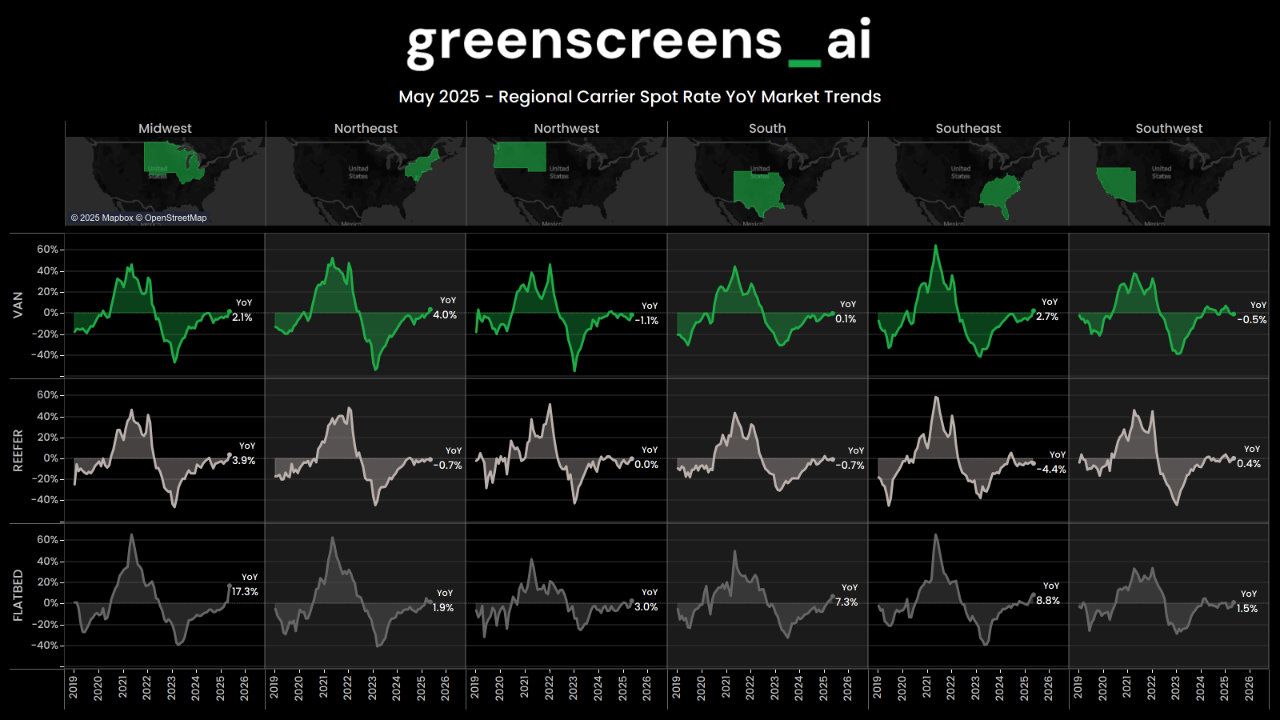
Van and reefer rates lag while flatbeds surge +17.3% in the Midwest. See Greenscreens.ai data, hot lanes, and key regional trends shaping U.S. freight.
Happy Thursday. If May felt like déjà vu, you’re not wrong. Spot market rates for vans and reefers kept sliding while flatbeds got their seasonal uptick.
According to Greenscreens.ai’s May 2025 Market Update, the U.S. freight market continues to reflect an economy stuck in neutral, strong in some corners, stalling in others.
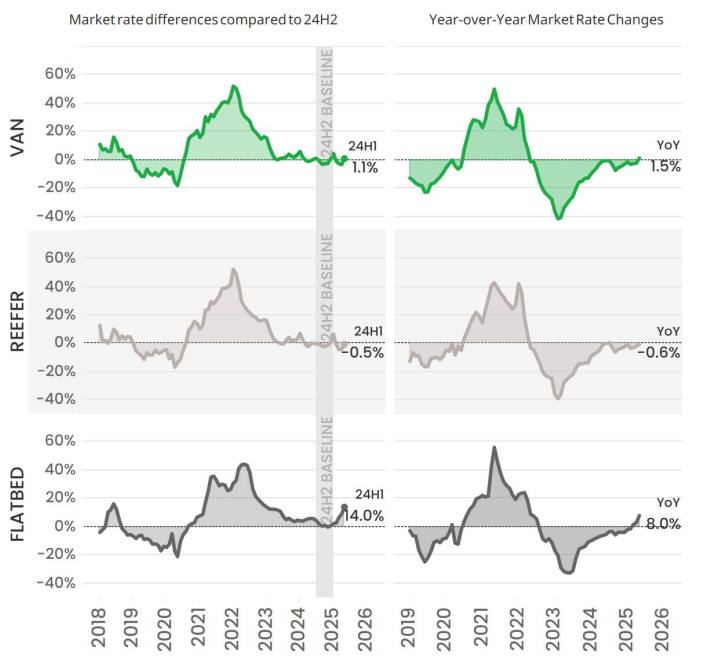
May 2025 national carrier spot rates and YoY Trends. Image Source: greenscreens.ai
Vans: Sluggish Despite Slight YoY Gain
Van rates are technically up +1.5% YoY, but that masks underlying weakness. Compared to the second half of 2024, rates in North and Southwest regions dropped by -11.1% and -4.4%, respectively.
Possible Factors:
A manufacturing slowdown. The ISM Manufacturing PMI hit 48.5 in May, the third straight month below the 50 threshold, signaling continued contraction.
At the same time, McKinsey reports a pullback in discretionary consumer spending, with shoppers across all income levels prioritizing essentials and avoiding splurges. That means fewer electronics, apparel, and consumer goods moving by dry van.
Reefers: Produce Season Fizzles
May should’ve been reefer season, but rates slipped -0.6% YoY and -0.6% vs. 2024 H2, according to Greenscreens.ai.
Carriers overcommitted, expecting volume surges that didn’t fully materialize.
Retailers, still dealing with elevated inventories, limited orders to reduce risk. This lines up with reports that many are scaling backon replenishment, especially in perishable categories.
Even strong produce markets in Florida and California couldn’t lift the segment enough to overcome overcapacity.
Flatbeds: Strongest Type
Flatbeds remain the best-performing equipment type, with spot rates up +14% vs. 2024 H2 and +8% YoY.
Though new housing construction is still down, demand for construction materials, machinery, and steel is being buoyed by:
Infrastructure projects, particularly in the South and Midwest
Energy sector growth
Federal grant rollouts that support public works and transportation investment
For now, flatbeds are benefiting from a unique mix of seasonality and industrial activity that hasn’t translated to other segments.
TrueNorth connects brokers with the right carriers—fast
Instead of passively posting and praying, TrueNorth’s AI Loadboard ensures your loads are only visible to qualified carriers in our 50,000+ strong network.
We then match your loads to carriers based on each carrier’s availability, location, and preferences.
And, we actively connect with the carriers to gauge interest and bring you a shortlist of ready-to-book carriers.
It’s like having a personal matchmaker for every load—designed to drive efficiency, prevent fraud, and close more freight, faster.
Greenscreens.ai offers a pulse check on where freight was strongest and weakest in May—and it’s clear the Southeast dominated, especially for vans and reefers.
Flatbed popped in the Midwest, up +17.3% YoY, and +8.8% in the Southeast, fueled by infrastructure and industrial demand.
Van rates climbed most in the Northeast at +4.0%, while the Northwest dropped to -1.1%.
Reefer was weakest in the Southeast, down -4.4%, despite peak produce season.
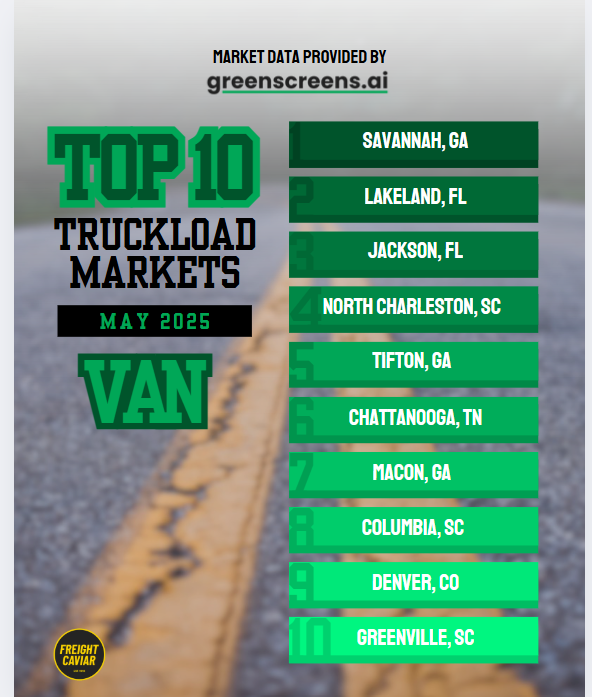
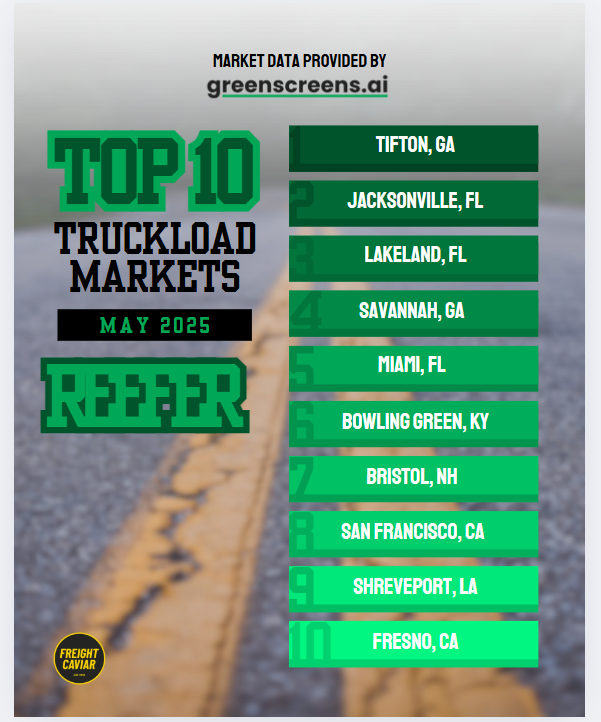
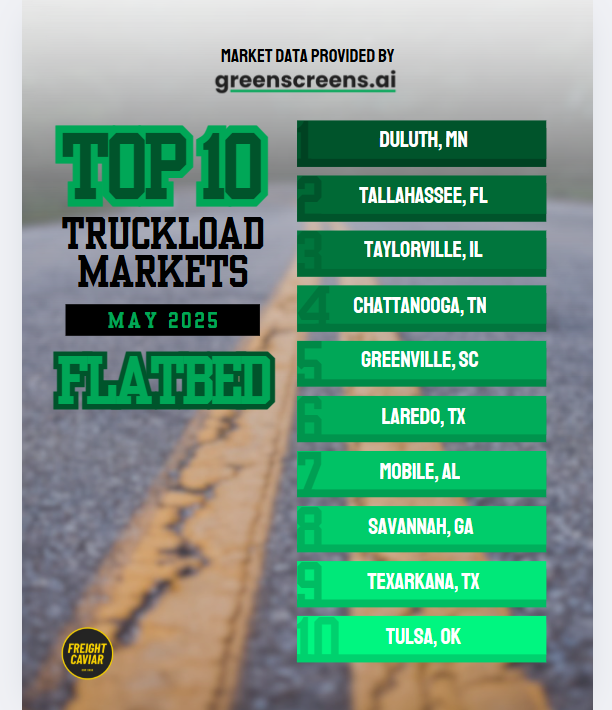
If you're hunting for where the freight action actually was in May, Greenscreens.ai's lane-level data highlights the top 10 performing truckload markets by equipment type.
Van Freight: Southeast Strongholds
While national van trends were underwhelming, the Southeast lit up the map. Key van origin markets include:
Many of these regions benefit from port access, warehousing networks, and relatively strong consumer-driven freight demand.
Reefer Freight: Produce Powerhouses
Even in a soft reefer season, produce lanes stayed active in:
These lanes reflect harvest timing and cold storage proximity, even if volumes didn't spike like in past years.
Flatbed Freight: Infrastructure-Driven Surge
Flatbeds saw broad geographic lift, particularly in areas tied to infrastructure and industrial freight:
These areas have been key players in construction material and machinery movement, fueled by both public and private projects.
Bottom Line: Brokers and carriers looking for traction in a lukewarm market should lean on regional intelligence. Knowing where capacity is tightening (or loosening) can offer a real edge.
FreightCaviar Exclusive. We talked with Karl Fillhouer, VP of Sales and Operations at Circle Logistics, to get his unfiltered take on the push for tougher enforcement of CDL English proficiency. From the risks to drivers and brokers to what shippers are demanding—and the heated social media debate this rule has sparked—we break it all down here.
Are You Subscribed? We hit the floor at the biggest logistics conference (TIA Capital Ideas 2025) to ask industry insiders one simple question: “Are you subscribed to FreightCaviar?” From legit readers to bluffers, see who’s in the know and who’s missing out on the industry’s best newsletter. Catch it on our YouTube channel.
FreightCaviar Forum: Now Live! A space built for brokers, carriers, dispatchers, and freight tech to connect, share, and learn from one another. Sign up now here.
I’m Adriana, a writer and editor at FreightCaviar. I’ve covered everything from freight tech to industry lawsuits and market shifts, helping scale us to almost 14K subscribers. My goal: to make logistics stories digestible, clear, and fun to read.
Tucker Carlson’s nicotine brand loses 378,000 tins in a cargo theft. Plus: produce rates reset, diesel climbs, and a bill that could pull hundreds of thousands of drivers off the road.
The Middle East crisis is already hitting carriers. Plus: Florida lost $3B in crops, flatbed rates posted a fifth straight weekly increase, a $5B brokerage was just acquired, and more.
Two bills just dropped in the Senate that could reshape trucking faster than anything since deregulation. Plus: Russian hackers targeted your load board, flatbed rejection rates just hit 40%, and a robot is taking the Houston-Dallas overnight run.
Keep up with the freight broker world in 5 minutes.
Join over 14K+ subscribers to get the latest freight news and entertainment directly in your inbox for free. Subscribe & be sure to check your inbox to confirm (and your spam folder just in case).