The Tab Count Is Killing Brokerage Margins

A practical look at how freight AI is evolving from simple automation to operational decision support, and what it means for broker productivity, tribal knowledge capture, and more.

The Tab Count Is Killing Brokerage Margins

Armstrong didn’t need “more AI.” It needed fewer tabs.

Because freight ops teams are still trying to run a modern business through a chaos stack: inbox triage, portal logins, TMS screens, Slack pings, and the classic internal wiki known as “ask Dave, he knows.”

Armstrong Transport Group’s Augment profile puts hard numbers on what that actually feels like on an ops floor:

  • 50–70 loads per operations specialist
  • 400+ emails a day
  • 20+ portals open at once

When that’s your baseline, the true problem is fragmentation.

And that’s what makes Armstrong’s story worth reading as something bigger than a testimonial. It’s a snapshot of what “freight AI in production” looks like in 2026: fewer shiny demos and more focus on a tool that’s forced to live inside the mess of real workflows, real exceptions, and real people trying to clock out.

The Real Pressure Isn’t “More Loads.” It’s More Everything.

Armstrong’s profile hits on a tension most brokerage leaders recognize instantly: margins can be thin (the profile calls out 2–3% as a common reality), yet service expectations keep rising, and finding, training, and keeping experienced operators remains a grind.

That creates a trap that looks like “growth” on paper but feels like slow collapse in the trenches:

  • To grow, you add headcount.
  • To protect quality, you add more headcount.
  • To stop burnout, you add more headcount.

Eventually, the math breaks. Not because the business isn’t selling, but because the operating system can’t keep up.

Armstrong’s bet was different: scale without scaling headcount 1:1.

What Changed For the Operator 

The most telling proof point in Armstrong’s profile isn’t even the productivity metric. It’s the lived experience.

William McManus, an Operations Specialist at Armstrong, described the job as having no off switch. After deploying Augie, he summarized the change with a line that will resonate with anyone who’s ever had to “just double-check a few things” at 4:45 p.m.:

“I finally get to log off when I log off.”

That one sentence is quietly expensive. Because the true cost of brokerage ops isn’t only payroll, it’s what happens when work spills past the edge of the day:

  • Errors that show up right before close
  • Time lost digging through email threads for a missed detail
  • “Hold on, let me check” moments that drag out service
  • Document stalls that stretch billing cycles
  • Burnout that turns into churn, and churn that turns into six-month retraining loops

Armstrong’s case argues that when you reduce fragmentation, you make the work more reliable. And reliability is the thing that actually protects margins.

Armstrong’s Results: Productivity, Cash Flow, and Morale (All Tied Together)

According to the profile, Armstrong saw measurable outcomes after bringing Augie into day-to-day operations:

  • Operators cut touches per load nearly in half
  • Billing sped up by 8 days
  • Carrier reps doubled the loads they could manage
  • Morale improved, including William getting his lunch back and not staying late to clean up what the day left behind

If you’re a broker leader, that’s not a “nice to have.” That’s operating leverage.

Because “8 days faster billing” isn’t just a process win. It’s cash flow. It has fewer AR headaches. It’s fewer moments where the business is profitable in theory, but waiting on paperwork in practice.

And “touches per load cut nearly in half” isn’t a vanity metric. It’s fewer handoffs, fewer chances to miss something, fewer points where a workflow breaks, and a human has to sprint in and rescue it.

The Bigger Point: Freight AI Is Starting to Split Into Two Layers

In the broader freight AI landscape right now, it’s easy to get distracted by novelty. Everyone has a demo. Everyone has an “agent.” Everyone has a tool that can reply to an email.

What’s harder to find is production-grade impact; these are tools that can sit inside messy workflows, across multiple channels, and still produce repeatable results without turning into a full-time IT project.

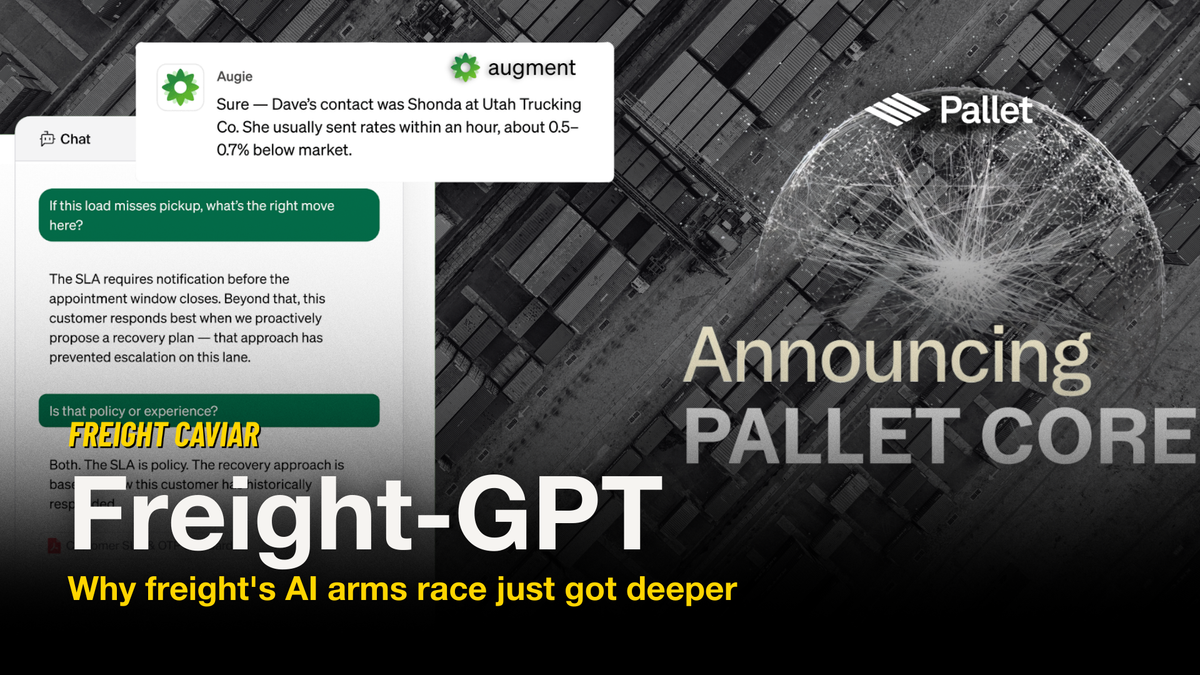
🎣 Freight-GPT
In just three years, we have moved from an industry that relied heavily on manual phone calls and emails to one where many of us use AI to some extent to support the above.

In a recent FreightCaviar interview with Augment CEO Harish Abbott, he described why the market feels both crowded and confusing right now: it’s become extremely easy to build prototypes, but still difficult (and expensive) to build systems that operate reliably at scale.

That distinction matters because it’s shaping where brokerages are actually putting dollars in 2026.

And it’s also why freight AI is starting to break into two layers:

1) The Speed Layer (automation)

This is what most people think of first:

  • Reduce repetitive touches
  • Automate track & trace
  • Collect documents
  • Build loads in the TMS
  • Pull updates into Slack/Teams instead of tab-hopping

Armstrong’s results sit here, and they’re meaningful precisely because they’re tied to measurable ops outcomes.

2) The Judgment Layer (tribal knowledge + decision support)

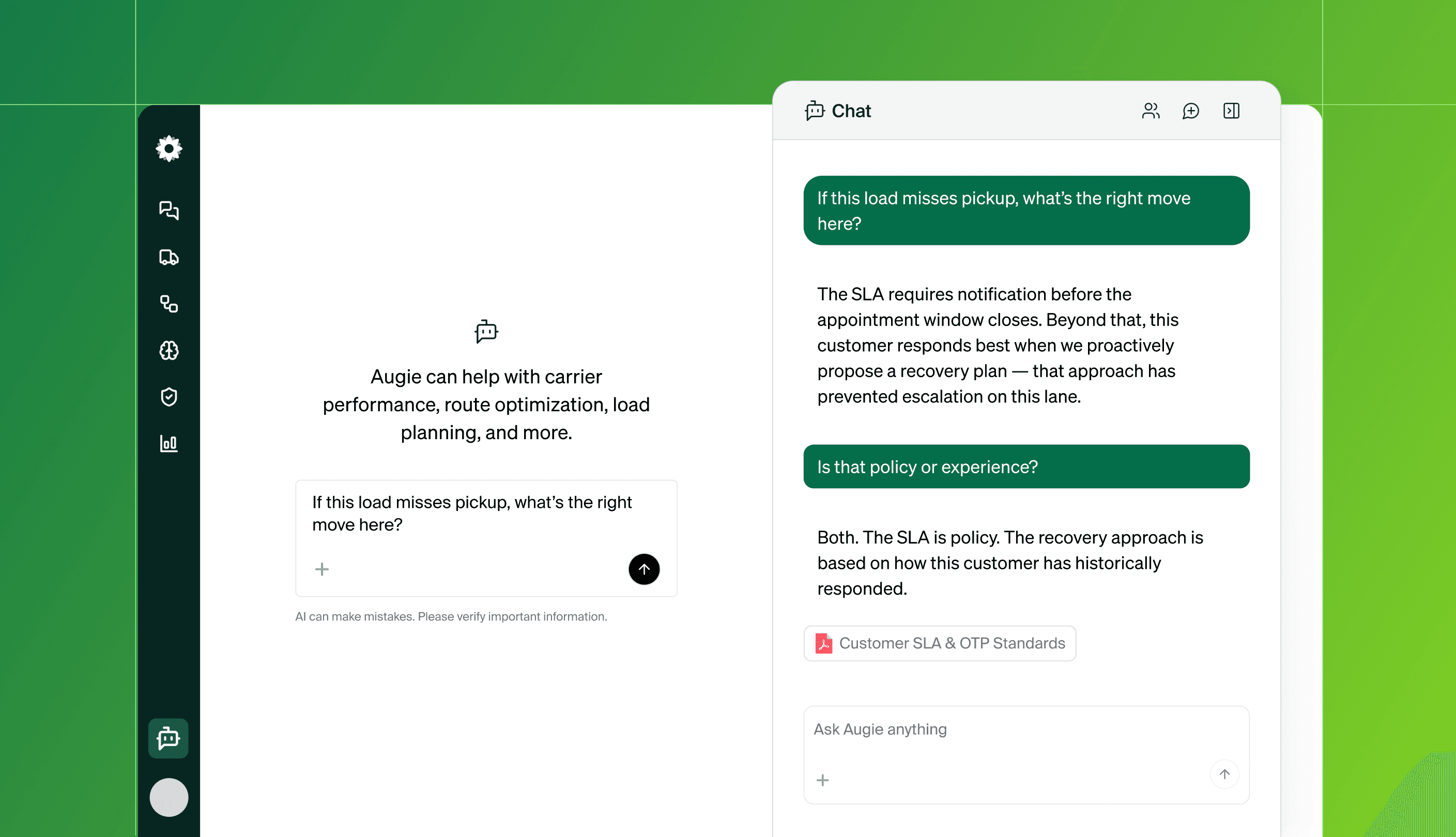
This is the part the industry is just now waking up to: the reason your best operators are “the best” isn’t only speed. It’s judgment — the accumulated experience of knowing what will go wrong, what a shipper actually cares about, and what the correct move is when reality doesn’t match the SOP.

Why We Built Knowledge Hub: The Question That Changed Everything - Augment
Stay ahead of the curve with the Augment Logistics Blog. Get the latest insights, trends, and best practices in AI for logistics, and discover how to optimize your operations.

Harish described it as the difference between making people faster… and making them 10x more capable.

And it’s the reason Augment recently launched its Knowledge Hub: a shared brain designed to capture SOPs, shipper expectations, facility rules, portal processes, internal best practices — plus the messy context that usually lives in inbox threads, Slack DMs, and people’s heads.

One question, he said, crystallized the need:

An operator asked: “Is this customer a churn risk?”

That’s not a tracking question. That’s judgment.

Answering it requires stitching together:

  • lane volumes and mix (spot vs contract)
  • pricing vs market context
  • performance (pickup vs delivery expectations differ by customer)
  • sentiment in emails, calls, and texts
  • historical patterns that live in tribal memory

That’s where freight AI starts moving from “task automation” to something closer to a brokerage operating system, one that works faster, yes,  but also helps operators make better decisions with less guesswork.

Why This Matters for Broker Leaders 

Armstrong’s story is a useful case study because it forces a hard question:

If your ops floor is already maxed out — not by load count, but by context switching — what’s your actual plan to scale?

Because “hire more people” is getting riskier:

  • Experienced operators are expensive
  • Training takes months
  • Turnover is high
  • & Constant churn quietly erodes service quality

Meanwhile, the market is still in a weird spot. Pricing pressure hasn’t disappeared. Shippers still want more visibility, faster responses, and fewer mistakes, even when rates don’t justify extra labor.

So the playbook brokerages are experimenting with now looks like this:

  • Reduce low-value touches
  • Compress billing cycles
  • Keep your best people from burning out
  • Use AI to turn ops from firefighting into offense (more proactive service, better shipper conversations, cleaner QBRs)

That’s also why “AI” is becoming less of a science project and more of a leadership decision.

As Harish put it, the bottleneck lies in how fast your workflows (and org chart) can change.

A Practical Checklist: 5 Questions to Ask Before You Bet on Freight AI

If Armstrong’s story sparked interest, don’t start with vendor features. Start with workflow reality.

Here are five questions any brokerage leader should ask when evaluating freight AI tools (Augment or otherwise):

  1. What workflows does it actually run end-to-end? Not “can it draft an email,” but can it operate from order → delivery → cash?
  2. How does it handle exceptions? Anyone can automate the happy path. What happens when something breaks at 4:45 p.m.?
  3. Where does your tribal knowledge live, and how does it stay current?SOPs, shipper quirks, facility rules, portal weirdness. If it changes weekly, can the system keep up?
  4. How will you measure ROI in the P&L?Touches per load, billing days, cost-to-serve, retention, escalations; pick metrics you can defend.
  5. What’s the implementation reality?Integration, security permissions, uptime expectations, and ongoing model changes. Production is the product.

The FreightCaviar Take: 2026 Won’t Be “More Tools.” It’ll Be Consolidation.

Armstrong’s experience points to a broader trend we’re seeing across the freight AI space: brokerages don’t have the bandwidth to integrate six different AI point solutions and change-manage them all.

The winners won’t be whoever has the flashiest demo. They’ll be whoever:

  • proves measurable outcomes in production
  • reduces fragmentation instead of adding to it
  • and makes the ops floor feel more human, not more chaotic

Or, in William’s words, the real ROI is when operators can actually log off when they log off.

Schedule a demo today to learn how Augment’s Augie and new Knowledge Hub help brokerages reduce manual touches, capture tribal knowledge, and scale operations without adding headcount. 


Great! You’ve successfully signed up.

Welcome back! You've successfully signed in.

You've successfully subscribed to FreightCaviar.

Success! Check your email for magic link to sign-in.

Success! Your billing info has been updated.

Your billing was not updated.